Why Webinar Scripting Is Your Silent Productivity Killer
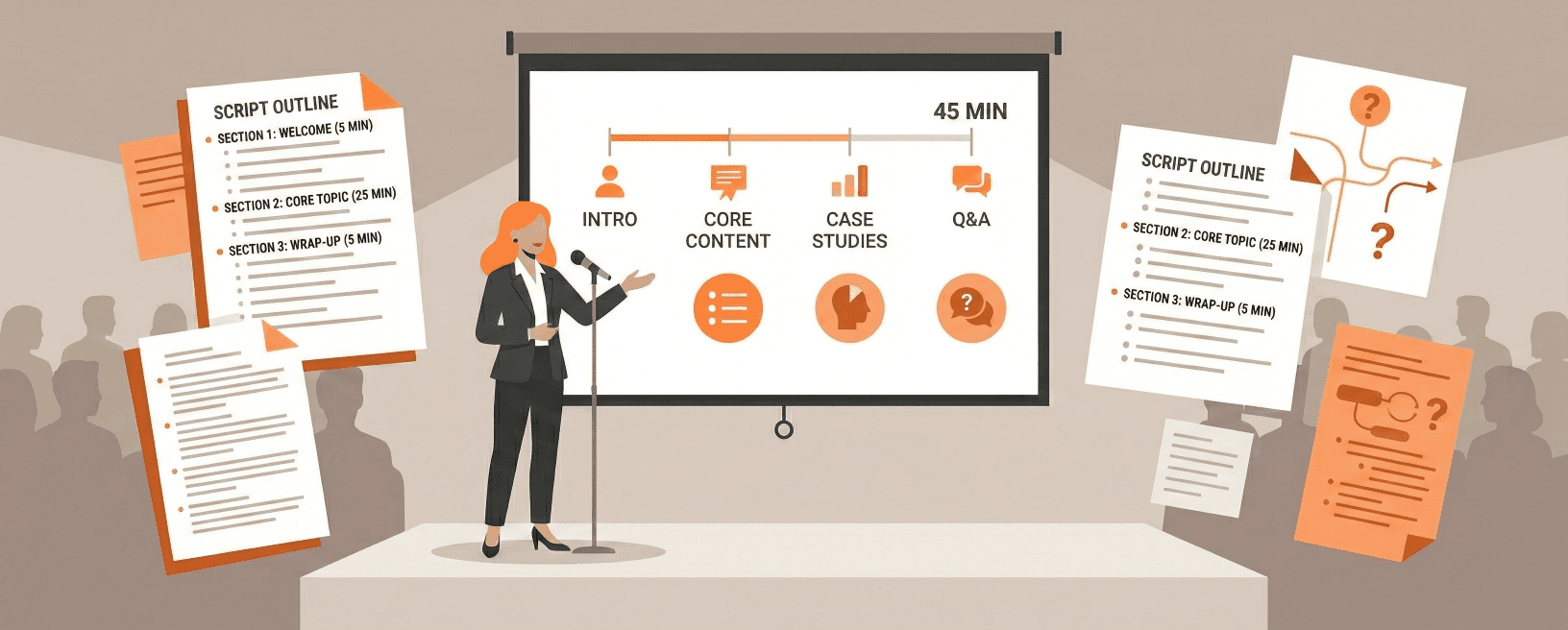
You've scheduled a webinar, promoted it across channels, and lined up speakers—then you face the blank page. You know the topic, but structuring 45 minutes of content that educates without boring, sells without being pushy, and maintains energy from intro to CTA is paralyzing. You outline sections, draft transitions, rewrite the opening hook five times, second-guess your Q&A prompts, and three days later you have a disjointed script that reads like a Wikipedia article interspersed with desperate sales pitches. Meanwhile, your webinar is in four days and you still need slides, promotional copy, and follow-up sequences.
Time saved: Reduces 6-8 hours of script drafting and revision to under 20 minutes
Consistency gain: Standardizes webinar structure across recurring events, ensuring every presentation includes proven engagement hooks, strategic content sequencing, and conversion-optimized CTAs
Cognitive load: Eliminates the anxiety of "Is this flow actually compelling?" and frees mental energy for refining delivery, coordinating speakers, and optimizing registration funnels
Cost comparison: Prevents revenue loss from poorly structured webinars—a well-scripted 45-minute presentation with strategic pacing can improve conversion rates by 20-30%, meaning a webinar with 200 attendees could generate 40-60 additional conversions worth thousands in pipeline value
This task is perfect for AI delegation because it requires narrative architecture (building coherent story arcs), audience psychology (maintaining attention and building desire), and format-specific structuring—exactly what AI handles efficiently when given proper direction about your content and audience.
Here's how to delegate this effectively using the 5C Framework.
Why This Task Tests Your Delegation Skills
Creating effective webinar scripts reveals whether you understand instructional design versus information dumping. A junior content creator can't generate conversion-driving webinar scripts without understanding your audience's knowledge level, what keeps them engaged through a 45-minute presentation, and how educational content should build toward a commercial outcome.
This is delegation engineering, not prompt hacking. Just like briefing a speechwriter, you must specify:
- Content architecture (how do you sequence information to build credibility then desire?)
- Engagement mechanisms (what keeps virtual audiences from multitasking through your presentation?)
- Conversion psychology (where do you earn the right to pitch, and how do you transition from teaching to selling?)
The 5C Framework forces you to codify these presentation design principles into AI instructions. Master this SOP, and you've learned to delegate any long-form content structuring task—from workshop curricula to podcast episode outlines.
Configuring Your AI for Webinar Script Creation
| 5C Component | Configuration Strategy | Why it Matters |
|---|---|---|
| Character | Presentation designer and instructional strategist, trained in adult learning principles, webinar engagement tactics, and persuasive storytelling frameworks (Hero's Journey, Problem-Agitate-Solve) | Ensures AI applies proven webinar structure—opening with pattern interrupts, using strategic reveal pacing, building credibility before pitching, designing micro-conversions throughout—not just outlining bullet points in sequence |
| Context | Webinar topic and learning objectives, target audience and their expertise level, desired outcome (lead generation/product demo/thought leadership), speaker expertise and presentation style, duration and format (solo/panel/interview) | Different webinar goals require different script architectures—a product demo needs problem-solution framing; thought leadership needs insight-driven narratives; lead magnets need value stacking. AI must understand what attendees came to learn versus what you want them to do |
| Command | Generate detailed webinar script with time-stamped sections, speaker notes, engagement prompts, slide cues, and transition language; structure content to maximize attention retention and build toward conversion moment | Prevents generic outlines that just list topics. AI should design attention architecture—strategic pacing with energy shifts, credibility building, objection handling, and natural transition to CTA—not just a chronological content dump |
| Constraints | Limit opening to 3-5 minutes before value delivery; include engagement prompts every 7-10 minutes; allocate 60-70% to teaching, 20-25% to soft selling, 10-15% to Q&A; avoid jargon-heavy sections longer than 5 minutes; include explicit permission-based transitions to sales content | Stops webinar bloat and attention leaks. Ensures script maintains energy through proven engagement patterns, earns credibility before pitching, and respects the "teach first, sell second" contract attendees expect from educational webinars |
| Content | Provide your core teaching points, case studies or examples to reference, common audience questions or objections, your product/service's value proposition, any brand voice guidelines or presentation conventions your company uses | Teaches AI your unique insights and proof points—generic webinar scripts feel like everyone else's. Real teaching comes from specific frameworks, stories, and data only you can provide. AI needs your raw expertise to structure compellingly |
The Copy-Paste Delegation Template
<role>
You are a webinar script specialist and presentation designer with expertise in adult learning theory, virtual engagement tactics, and conversion-focused content architecture. You understand how to structure 45-60 minute presentations that educate authentically while building desire for commercial outcomes—without feeling like a bait-and-switch sales pitch.
</role>

<context>
I need a webinar script for a 45-minute presentation on [your topic].

Webinar details:
- Topic/title: [what you're teaching]
- Target audience: [role, industry, expertise level]
- Primary learning objective: [what should attendees be able to do/understand after?]
- Webinar goal: [lead generation / product demo / thought leadership / course enrollment]
- Format: [solo presentation / interview / panel / demo]
- Speaker(s): [name(s) and relevant expertise/credentials]
- What you're offering at the end: [product/service/course/consultation—be specific]

Content parameters:
- Total duration: 45 minutes
- Desired breakdown: [X minutes teaching, Y minutes Q&A, Z minutes for CTA/offer]
- Key concepts to cover: [list 3-5 main teaching points]
- Proof points available: [case studies, data, testimonials, examples]
- Common audience objections or questions: [what skepticism will you face?]

Presentation style: [conversational and story-driven / data-heavy and analytical / interactive with exercises / demo-focused]
</context>

<instructions>
Follow this webinar scripting sequence:

1. **Design opening hook (3-5 minutes)** that accomplishes three things:
- Pattern interrupt (surprising stat, provocative question, relatable story—something that breaks distracted scrolling)
- Credibility establishment (why should they listen to you? Keep it brief and relevant, not a full bio)
- Outcome promise (what specific transformation or insight will they gain? Be concrete, not generic)
Structure: Start with hook → establish credibility → preview what they'll learn → set engagement expectations ("I'll pause for questions every 10 minutes")

2. **Build main content architecture** using proven engagement pacing:
- Break core teaching into 3-4 major sections (10-12 minutes each)
- Within each section: TEACH concept → SHOW example/case study → APPLY with audience prompt (poll, chat question, mental exercise)
- Sequence sections from foundational (awareness) → practical (application) → advanced (mastery teaser)
- Include "bridge language" between sections that maintains narrative flow (not abrupt topic switches)
- For each section, note: [Time stamp] [Section title] [Key teaching points] [Examples to use] [Engagement prompt] [Transition to next section]

3. **Integrate strategic credibility and proof points** throughout teaching (not saved for pitch):
- Weave in case study results, customer stories, or data naturally as teaching examples
- Position yourself as guide who has solved this problem, not guru lecturing from ivory tower
- Address potential objections or skepticism as teaching points before the pitch (builds trust)

4. **Design conversion bridge (5-7 minutes)** that transitions from teaching to offering:
- Acknowledge the "implementation gap" (they now understand concepts, but need help executing)
- Introduce your solution as natural next step, not jarring sales pivot
- Present offer as opportunity, not pressure (permission-based: "For those interested in going deeper...")
- Include clear value proposition: what they get, how it solves the problem you just taught about, what makes it different
- Provide specific CTA with next steps (book call, visit page, use discount code—one primary action)

5. **Structure Q&A strategy (10-15 minutes):**
- Plant 2-3 strategic questions you want to answer (have presenter or moderator seed these if needed)
- Provide guidance on handling common questions (including objections about your offer)
- Note which questions to answer fully vs. which to "take offline" (respect time)
- Include closing statement after Q&A that reinforces key takeaway and repeats CTA

6. **Add presenter notes and production cues:**
- [SLIDE: description] for key visual moments
- [POLL/CHAT: prompt] for engagement beats
- [TONE: directive] when energy shifts (enthusiasm, seriousness, empathy)
- [PAUSE: X seconds] for dramatic effect or reflection
- Time stamps for each section so presenter can pace appropriately

Output as a formatted script with clear section headers, time allocations, speaker notes in brackets, and transition language written out fully (not just "transition to next section").
</instructions>

<input>
Provide your content and context below:

**Core teaching points you want to cover:**
[List the 3-5 main concepts, frameworks, or insights you'll teach]

**Examples, case studies, or proof points:**
[Describe specific stories, data points, or customer results you can reference]

**Common audience questions or objections:**
[What do people typically struggle with or doubt about this topic?]

**Your offer details:**
[What are you selling/promoting? What does it include? What's the value proposition? What's the CTA?]

**Your presentation style preferences:**
[Formal vs. conversational? Story-heavy vs. data-driven? Interactive vs. lecture? Any specific conventions or phrases you use?]

Example input:
"Teaching points: (1) Why most delegation fails—manager mindset vs. task mindset, (2) The 5C Framework overview, (3) Live delegation example with audience participation.
Case studies: Customer saved 15 hours/week using framework, team scaled AI delegation across 8 departments.
Objections: 'I don't have time to learn prompting' / 'AI makes mistakes' / 'My tasks are too complex'
Offer: Sorai Academy course—$497, includes 12 modules + templates + community. CTA is to book strategy call or enroll directly with early-bird discount.
Style: Conversational and story-driven, use sports analogies, interactive polls every 10 minutes."

[PASTE YOUR INPUTS HERE]
</input>
The Manager's Review Protocol
Before finalizing AI-generated webinar scripts, apply these quality checks:
- Accuracy Check: Verify all facts, statistics, case study details, and teaching points are correct—did AI accurately represent your frameworks, methodologies, or data? Confirm that time allocations are realistic (can you actually cover that content in the minutes allotted?). Cross-check that your offer details, pricing, and CTA instructions are accurate and match your actual landing page or enrollment process.
- Hallucination Scan: Ensure AI didn't invent case studies, customer results, or proof points that don't exist. Check that teaching frameworks haven't been embellished with fake statistics or sources. Verify that transition logic makes sense—are sections actually building on each other or did AI create artificial connections between unrelated concepts? Watch for generic webinar filler ("As we all know..." "Studies show...") that sounds authoritative but says nothing specific.
- Tone Alignment: Confirm the script matches your actual presentation style—is the energy level sustainable for 45 minutes? Does the language sound like how you actually speak, or is it stilted corporate presentation-speak? Check that the teaching-to-selling ratio feels authentic (not too aggressive or too timid). Ensure engagement prompts fit your personality (if you're not naturally playful, don't include cutesy polls). Verify that the script gives you flexibility to riff naturally, not a rigid teleprompter text.
- Strategic Fitness: Evaluate whether the script architecture actually serves your conversion goal—does the teaching content genuinely build credibility and position your offer as the logical next step? Are objections being addressed before the pitch, not ignored? Is the CTA strong and clear, or buried? Check that engagement mechanisms are strategically placed at attention dip points (8-12 minutes in, post-technical sections, right before pitch). Strong delegation means recognizing when AI created a generically structured webinar versus one that leverages persuasion psychology for your specific audience and offer.
Build your SOP Library, one drop at a time.
We are constantly testing new ways to delegate complex work to AI. When we crack the code on a new "Job to be Done," we send the SOP directly to you, fresh from the lab.
Our Promise: High signal, low noise. We email you strictly once a week (max), and only when we have something worth your time.
When This SOP Isn't Enough
This SOP solves single webinar script creation, but content managers typically face webinar program optimization—coordinating script templates across recurring series, ensuring messaging consistency between webinar content and supporting materials (landing pages, emails, slides), and systematizing post-webinar conversion sequences. The full 5C methodology covers multi-format content repurposing (turning webinar scripts into blog posts, social content, and email courses), audience segmentation frameworks (customizing webinar scripts for different buyer personas or industries), and conversion funnel integration (connecting webinar content to broader customer journey stages).
For standalone webinars, this template works perfectly. For managing webinar series, building automated evergreen webinar systems, or creating comprehensive educational content programs, you'll need the advanced delegation frameworks taught in Sorai Academy.