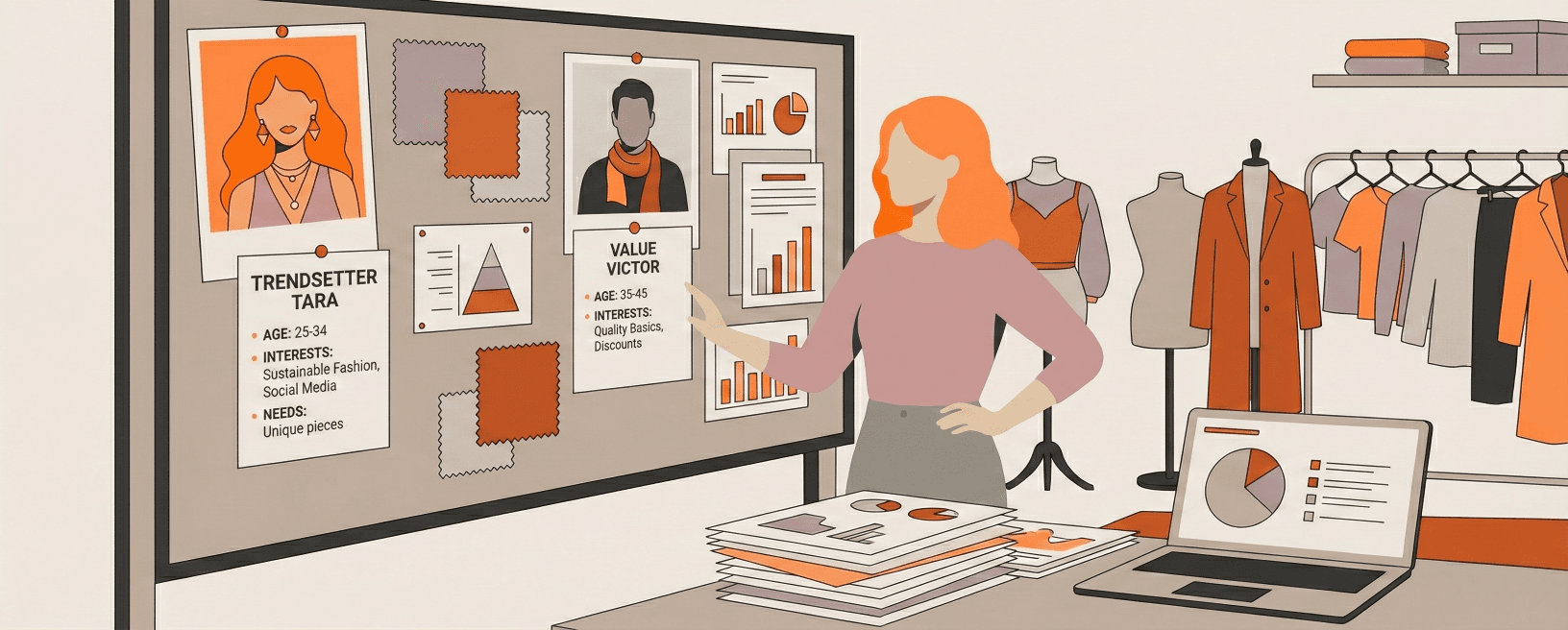
Why Buyer Persona Development Is Draining Your Strategic Bandwidth
You know customer personas matter, but creating them feels like archaeology without a map. You sift through scattered CRM data, half-remembered sales calls, support tickets from three platforms, and that one brilliant customer interview transcript you can't find. Six hours later, you've produced a persona document with generic demographics ("Sarah, 35-44, values quality") that tells marketing nothing actionable. Meanwhile, your actual strategic work—the decisions only you can make—sits untouched.
Time saved: Reduces 4-6 hours of persona research and synthesis to 20 minutes of structured data gathering plus 10 minutes of AI processing
Consistency gain: Standardizes persona frameworks across products and campaigns, ensuring every team member references the same customer insights and decision criteria instead of working from conflicting assumptions
Cognitive load: Eliminates the mental overhead of synthesizing hundreds of data points, pattern-matching across customer segments, and translating behavioral signals into marketing-relevant insights
Cost comparison: Prevents the $2,000-5,000 expense of outsourcing persona development to research consultants for every product launch or campaign refresh—while maintaining higher accuracy through direct access to your proprietary customer data
This task is perfect for AI delegation because it requires synthesizing qualitative and quantitative inputs, identifying behavioral patterns across disparate data sources, and translating raw information into structured profiles. AI excels at finding signal in noise, connecting demographic data to psychographic insights, and maintaining consistent formatting across multiple persona documents.
Here's how to delegate this effectively using the 5C Framework.
Why This Task Tests Your Delegation Skills
Buyer persona creation reveals whether you understand the difference between data dumping and insight synthesis. A junior analyst can compile statistics; a competent strategist transforms customer signals into actionable targeting criteria. Without clear direction, AI produces the same generic personas cluttering your competitor's marketing decks.
This is delegation engineering, not prompt hacking. Just like briefing a market research analyst, you must specify:
- Data quality standards (which customer signals matter versus which create false patterns?)
- Insight hierarchy (what separates a useful persona from demographic trivia?)
- Application context (how will marketing, sales, and product teams actually use these personas?)
The 5C Framework forces you to codify your customer understanding into AI instructions. Master this SOP, and you've learned to delegate any research synthesis task—from competitive analysis to customer journey mapping to market segmentation.
Configuring Your AI for Buyer Persona Creation
| 5C Component | Configuration Strategy | Why it Matters |
|---|---|---|
| Character | Market research analyst with B2B/B2C expertise (match your business model), trained in Jobs-to-be-Done methodology and behavioral segmentation frameworks | Ensures AI applies research rigor—identifying pain points versus surface complaints, distinguishing correlation from causation, framing insights as actionable targeting criteria rather than demographic lists |
| Context | Your industry, product category, typical sales cycle length, primary distribution channels, whether personas inform acquisition vs. retention strategies | Different business models require different persona depth—enterprise B2B needs decision-making unit mapping; e-commerce needs micro-moment triggers; SaaS needs feature adoption patterns |
| Command | Synthesize customer data into 3-5 distinct personas with demographic, psychographic, behavioral, and motivational dimensions; structure each with goals, pain points, decision criteria, and channel preferences | Prevents generic output by forcing AI to connect observable data (what customers do) to underlying motivations (why they do it)—the difference between "uses mobile apps" and "values on-the-go access because of field work demands" |
| Constraints | Base personas only on provided data; flag assumptions requiring validation; exclude PII; limit to 3-5 personas (more creates dilution); assign percentage of total market to each segment | Stops persona proliferation and fantasy customer syndrome—AI must work from evidence, acknowledge data gaps, and prioritize statistically significant segments over edge cases |
| Content | Provide examples of strong personas from past campaigns (if available), your preferred persona template format, specific frameworks you use (e.g., empathy mapping, value proposition canvas) | Teaches AI your organization's conventions—whether personas include day-in-the-life narratives, quote real customers, map to specific product features, or integrate with sales playbooks |
The Copy-Paste Delegation Template
<role>
You are a market research analyst specializing in customer segmentation and buyer persona development. You understand the difference between demographic data (who customers are), psychographic insights (how they think), and behavioral patterns (what they do). You create personas that inform targeting decisions, messaging strategy, and product positioning.
</role>

<context>
I need buyer personas for [product/service name] in the [industry] space. Our business model is [B2B/B2C/B2B2C], with an average [sales cycle length] and [price point range]. These personas will primarily inform [marketing campaigns / product development / sales enablement / all three].

Our target market characteristics:
- Company size (if B2B): [employee count / revenue range]
- Geographic focus: [regions/countries]
- Primary sales channels: [direct sales / e-commerce / channel partners / hybrid]
- Key differentiators: [what makes our solution unique]

Persona application: These will be used by [marketing/sales/product teams] to [specific use case: develop ad targeting / create email sequences / prioritize feature requests / etc.].
</context>

<instructions>
Follow this sequence to create research-grade buyer personas:

1. **Analyze provided data sources** to identify:
- Demographic patterns (age, role, company size, industry) across customer segments
- Behavioral signals (purchase triggers, research patterns, feature usage, churn indicators)
- Psychographic markers (values, priorities, fears, aspirations mentioned in qualitative feedback)
- Decision-making criteria (what makes customers choose you vs. alternatives)

2. **Segment customers into 3-5 distinct personas** using this logic:
- Group by shared goals and pain points (not just demographics)
- Ensure each segment represents at least 10-15% of your customer base
- Distinguish segments by meaningfully different needs or buying behaviors
- Name personas using memorable archetypes (e.g., "Efficiency-Driven Emma" not "Persona A")
- Assign approximate percentage of total addressable market to each persona

3. **Structure each persona using this framework:**

**[Persona Name & Archetype]**
*[One-sentence description of who they are and their primary goal]*

**Demographics:**
- Role/Title: [specific job function]
- Industry/Sector: [if applicable]
- Company Size: [if B2B]
- Age Range: [if relevant to product]
- Experience Level: [years in role/industry]

**Goals & Motivations:**
- Primary Goal: [what they're trying to achieve—be specific]
- Success Metrics: [how they measure success in their role]
- Career/Business Drivers: [what motivates their decisions]

**Pain Points & Challenges:**
- [Pain Point 1]: [specific, observable challenge with business impact]
- [Pain Point 2]: [include how they currently attempt to solve it]
- [Pain Point 3]: [note if this is recognized or latent]

**Decision-Making Criteria:**
- Must-Have Requirements: [non-negotiable features or attributes]
- Evaluation Process: [how they research and compare solutions]
- Key Objections: [what makes them hesitate or walk away]
- Influencers: [who else impacts their decision—if B2B include DMU roles]

**Behavioral Patterns:**
- Information Sources: [where they research solutions—channels, publications, communities]
- Buying Triggers: [what events prompt them to seek solutions]
- Preferred Communication: [email vs. phone vs. self-service vs. consultative]
- Technology Adoption: [early adopter vs. pragmatist vs. conservative]

**Brand & Messaging Alignment:**
- Resonant Messaging: [value propositions that matter to this persona]
- Language Preferences: [technical vs. business outcomes vs. emotional benefits]
- Proof Points Needed: [case studies / data / testimonials / certifications]

**Channel Preferences:**
- Discovery Channels: [where they first encounter solutions]
- Engagement Channels: [where they prefer ongoing interaction]
- Content Preferences: [formats and topics they consume]

4. **Apply research quality standards:**
- Distinguish between data-supported insights and assumptions (flag assumptions clearly with [ASSUMPTION - REQUIRES VALIDATION])
- Connect each persona attribute back to provided data—avoid generic statements
- Identify conflicting signals or edge cases that don't fit clean segmentation
- Note data gaps that limit persona confidence

5. **Provide strategic guidance:**
- Rank personas by strategic priority (market size + alignment with business goals)
- Suggest which personas represent best growth opportunities vs. maintenance segments
- Identify personas with significantly different needs requiring tailored approaches
- Flag if current data suggests fewer or more personas than requested

Output each persona as a structured profile ready for team distribution. After all personas, include a one-paragraph strategic summary comparing segments and recommending focus areas.
</instructions>

<input>
**Customer Data Sources:**
Paste relevant data below—the more context you provide, the more accurate and specific your personas will be. Include any combination of:

- CRM data exports (anonymized): purchase history, company demographics, deal sizes
- Customer interview transcripts or survey responses (qualitative feedback)
- Support ticket themes and common questions
- Sales call notes or lost deal analyses
- Website analytics showing user behavior patterns
- Email engagement data or content consumption patterns
- Social media insights or community discussion themes
- Competitive win/loss analysis

Example input:
"CRM data: 60% of customers are marketing managers at 50-200 employee SaaS companies, average deal size $15K annually. Survey responses (n=120): top pain point is 'disjointed data across tools' (mentioned 78 times), second is 'proving ROI to leadership' (mentioned 64 times). Support tickets: most common issue is integration setup (35% of tickets), followed by reporting customization (28%). Sales notes: lost deals primarily due to 'too complex for team size' or 'lacking specific integration'. Win factors: 'ease of use' and 'fast time-to-value' mentioned in 80% of closed-won deals..."

[PASTE YOUR CUSTOMER DATA HERE]

**Additional Context (Optional):**
- Existing personas you want to refresh or validate
- Specific questions these personas need to answer
- Known customer segments you want AI to investigate further
- Hypotheses about customer motivations you want tested against data
</input>
The Manager's Review Protocol
Before deploying AI-generated personas to your teams, apply these quality checks:
- Accuracy Check: Verify persona attributes match your actual customer data—did AI correctly interpret survey responses, CRM patterns, and behavioral signals? Cross-reference key statistics (market percentages, pain point frequencies, demographic distributions) against source data. Confirm personas reflect observable customer reality, not AI's generic assumptions about "typical" buyers in your industry.
- Hallucination Scan: Ensure AI didn't invent pain points, goals, or behaviors absent from your input data. Watch for suspiciously specific details (exact quotes, precise statistics, named tools/competitors) that weren't in source materials. Verify any stated assumptions are flagged as [ASSUMPTION] rather than presented as fact. Check that decision-making criteria and channel preferences come from evidence, not AI's imagination about how customers "should" behave.
- Tone Alignment: Confirm persona language matches how your organization discusses customers—some companies prefer data-driven clinical language ("Segment B exhibits price sensitivity"), others use narrative empathy ("Emma struggles with..."). Ensure personas avoid stereotypes or reductive characterizations. Verify the level of detail matches your team's sophistication—junior marketers need more context; experienced teams want concise targeting criteria.
- Strategic Fitness: Evaluate whether personas serve your actual business decisions—can marketing build campaigns from these insights? Can sales customize pitches? Can product prioritize features? Strong personas connect observable behaviors to underlying motivations, enabling teams to predict how customers will respond to new offerings. If personas feel like demographic spreadsheets rather than strategic tools, AI missed the "why" behind the "what."
Build your SOP Library, one drop at a time.
We are constantly testing new ways to delegate complex work to AI. When we crack the code on a new "Job to be Done," we send the SOP directly to you, fresh from the lab.
Our Promise: High signal, low noise. We email you strictly once a week (max), and only when we have something worth your time.
When This SOP Isn't Enough
This SOP solves single-product persona development, but managers typically face dynamic customer intelligence—tracking persona evolution as markets shift, mapping persona-specific customer journeys, maintaining persona accuracy as your product expands into new segments, and connecting personas to attribution data showing which segments drive revenue. The full 5C methodology covers continuous research workflows (automating quarterly persona updates from fresh data), cross-functional persona activation (building persona-specific sales playbooks, ad campaigns, and product roadmaps), and predictive segmentation (identifying emerging customer patterns before they reach statistical significance).
For standalone persona projects, this template delivers immediately actionable profiles. For building customer intelligence systems, multi-product portfolio segmentation, or account-based marketing persona hierarchies, you'll need the advanced delegation frameworks taught in Sorai Academy.