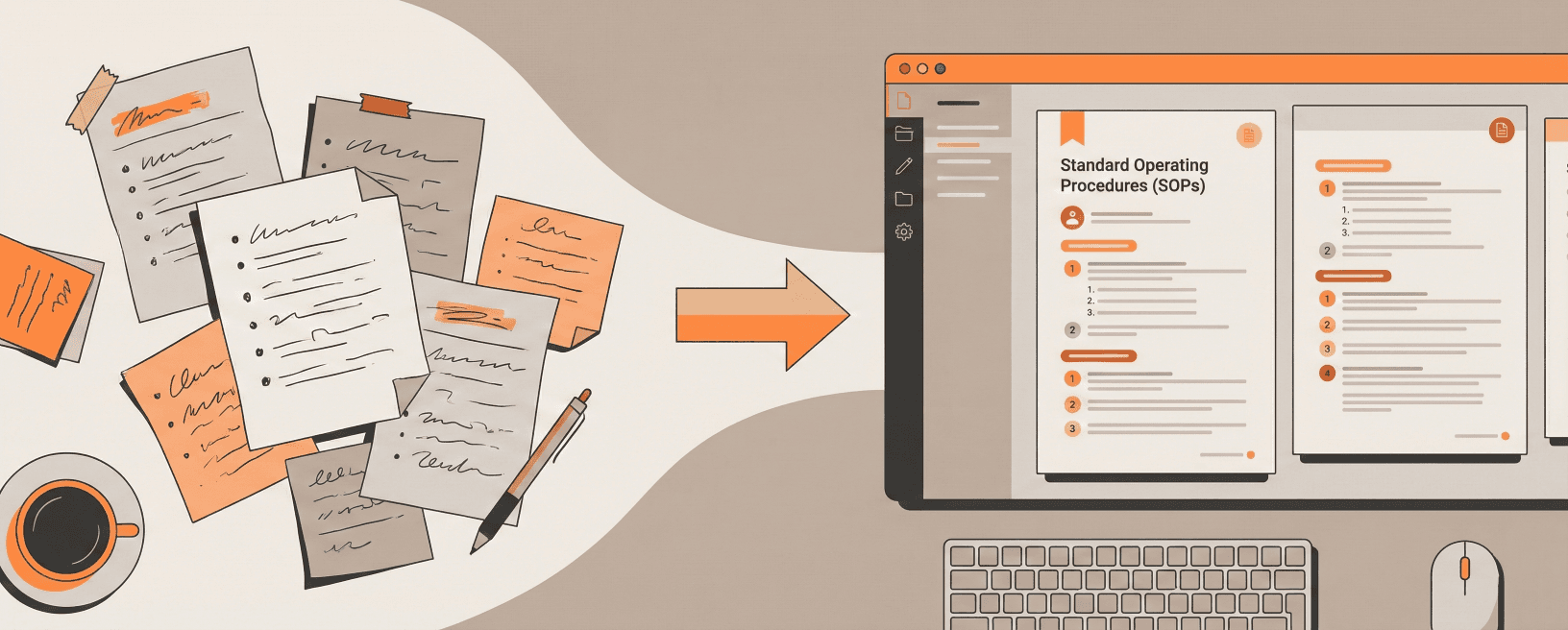
Why SOP Formatting Is Stealing Your Strategic Time
You've spent weeks refining a critical operational process—customer onboarding, quality control, incident response—and captured the essential steps in rough notes. Now you face the soul-crushing final mile: transforming bullet points into a professional, scannable, consistently formatted policy document. You wrestle with heading hierarchy, numbering systems, and whether step 2.3.1 should really be 2.4. Two hours later, you're still adjusting margins instead of rolling out the process that will actually improve operations.
Time saved: Reduces 2-3 hours of formatting labor to under 10 minutes
Consistency gain: Standardizes documentation structure across all SOPs, ensuring team members can quickly navigate any procedure using familiar formatting patterns
Cognitive load: Eliminates the mental context-switching between "what should this process say" and "how should this document look," preserving focus for substantive policy work
Cost comparison: Prevents documentation bottlenecks—when managers avoid creating SOPs due to formatting overhead, teams operate without standardization, costing thousands in inefficiency and errors
This task is perfect for AI delegation because it requires structural organization (logical hierarchy), formatting consistency (style application), and professional presentation—exactly what AI excels at when given clear document specifications.
Here's how to delegate this effectively using the 5C Framework.
Why This Task Tests Your Delegation Skills
Formatting SOPs reveals whether you understand specification versus execution. A junior operations coordinator can't transform rough content into professional documentation without knowing your organization's formatting standards, logical grouping principles, and what makes procedures actually usable.
This is delegation engineering, not prompt hacking. Just like training a documentation specialist, you must define:
- Structural rules (when does a step become a sub-step versus a new section?)
- Formatting conventions (how are warnings, notes, and examples distinguished?)
- Usability standards (what layout helps people execute procedures under pressure?)
The 5C Framework forces you to codify these documentation principles into AI instructions. Master this SOP, and you've learned to delegate any content structuring task—from policy drafting to training manual creation to process documentation.
Configuring Your AI for SOP Formatting
| 5C Component | Configuration Strategy | Why it Matters |
|---|---|---|
| Character | Technical writer and operations documentation specialist with expertise in ISO standards and usability-focused procedure design | Ensures AI applies documentation best practices—using imperative voice for steps, placing warnings before actions, grouping related procedures logically—not just applying arbitrary formatting |
| Context | Your organization's SOP template requirements, industry standards (manufacturing/healthcare/IT/etc.), audience technical level, document management system constraints | Different contexts need different formats—healthcare SOPs require regulatory compliance sections; IT procedures need troubleshooting flowcharts; manufacturing specs need equipment lists and safety protocols |
| Command | Transform rough content into formatted SOP following template specifications; organize steps hierarchically; add standard document elements (purpose, scope, definitions); preserve all technical accuracy | Prevents AI from "improving" content by changing technical details or procedural order—formatting is about presentation, not rewriting the process you've already validated |
| Constraints | Never alter step sequence or technical content; maintain existing safety warnings and critical notes; limit procedures to 2-3 hierarchy levels max (avoid 1.2.3.4 complexity); flag ambiguous content requiring clarification | Stops AI from creating unusable documents—procedures buried four levels deep are hard to follow, and "improved" technical language might introduce errors when specialists rely on precise terminology |
| Content | Provide 1-2 examples of properly formatted SOPs from your library, showing your preferred numbering style, section headers, and how you distinguish notes/warnings/examples | Teaches AI your organization's specific conventions—whether you use alphanumeric (1.A.i) or decimal (1.1.1) numbering, how you format decision points, whether you include version history tables |
The Copy-Paste Delegation Template
<role>
You are a technical writer and documentation specialist with 10+ years creating operational procedures for corporate environments. You understand how to structure information for clarity, consistency, and usability under time pressure. You follow documentation standards and recognize that good formatting enhances procedure adoption.
</role>

<context>
I need you to format rough SOP content into a professional policy document.

Document specifications:
- Industry/context: [healthcare/manufacturing/IT/professional services/etc.]
- Intended audience: [job role and technical level]
- Document system: [if relevant - SharePoint/Confluence/Google Drive/PDF]
- Compliance requirements: [if applicable - ISO 9001/SOX/HIPAA/none]

Required SOP sections:
1. Document Header (Title, ID, Version, Date, Owner)
2. Purpose & Scope
3. Definitions (if needed)
4. Procedure Steps
5. Related Documents
6. Revision History

Formatting preferences:
- Numbering style: [decimal 1.1 / alphanumeric 1.A / your preference]
- Maximum hierarchy depth: [2 or 3 levels]
- How to handle warnings: [BOLD / boxed / your preference]
- How to handle notes: [italics / indented / your preference]
</context>

<instructions>
Follow this sequence:

1. **Analyze the rough content** to identify:
   - Main procedure steps vs. sub-steps vs. supporting information
   - Safety warnings or critical cautions
   - Decision points or conditional branches ("if X, then Y")
   - Examples, notes, or clarifying information
   - Missing standard elements (purpose statement, definitions, etc.)

2. **Structure the hierarchy** using these principles:
   - Top level (1.0): Major procedure phases or distinct processes
   - Second level (1.1): Individual steps within a phase
   - Third level (1.1.1): Sub-steps only when absolutely necessary
   - Avoid going deeper than three levels—if tempted, the procedure may need restructuring

3. **Apply formatting consistently:**
   - Use imperative voice for all action steps ("Click Submit" not "User clicks Submit")
   - Place warnings BEFORE the step they relate to
   - Use consistent formatting for similar elements (all notes italic, all warnings bold, etc.)
   - Number steps sequentially—no skipped numbers or letter-number mixing within levels
   - Include clear visual breaks between major sections

4. **Add required document elements:**
   - **Purpose:** 2-3 sentences explaining what this SOP accomplishes and why it exists
   - **Scope:** Who uses this, when, and any explicit exclusions
   - **Definitions:** Key terms that aren't common knowledge for the audience
   - **Related Documents:** References to prerequisite SOPs, forms, or policies
   - **Revision History:** Table format if content provided, otherwise note "Initial version"

5. **Structure output** in this format:

[DOCUMENT HEADER]
SOP Title: [Descriptive title]
Document ID: [If provided]
Version: [If provided, else 1.0]
Effective Date: [Today's date if not specified]
Owner: [Role/department if provided]
PURPOSE
[What this procedure accomplishes]
SCOPE
[Who uses this and when]
DEFINITIONS (if needed)
[Term]: [Definition]
PROCEDURE
1.0 [Major Phase]
1.1 [Step description]
1.2 [Step description]
1.2.1 [Sub-step if necessary]
WARNING: [If applicable]
1.3 [Step description]
NOTE: [If applicable]

2.0 [Next Major Phase]
[Continue pattern]
RELATED DOCUMENTS

[Reference document 1]
[Reference document 2]

REVISION HISTORY
[Version] | [Date] | [Author] | [Changes]

6. **Quality controls:**
   - Verify every step is actionable and uses imperative voice
   - Check that numbering is sequential with no gaps
   - Confirm warnings appear before related steps
   - Ensure document flows logically from start to finish
   - Flag any rough content that lacks sufficient detail for clear formatting

Output as a complete, formatted SOP document ready for review and approval.
</instructions>

<input>
Paste your rough SOP content below (bullet points, notes, partial drafts—any format):

Example format:
"Customer onboarding process
- need to verify identity first
- then create account in CRM
  - check for duplicates!!
  - assign account number
- send welcome email with login
- schedule kickoff call within 48hrs
NOTE: if enterprise customer need VP approval before account creation
..."

[PASTE YOUR ROUGH SOP CONTENT HERE]
</input>
The Manager's Review Protocol
Before distributing AI-formatted SOPs to your team or submitting for approval, apply these quality checks:
- Accuracy Check: Verify AI preserved all technical content exactly—did step sequences remain unchanged? Are safety warnings still present and in the correct locations? Confirm specialized terminology wasn't "simplified" in ways that change meaning. Check that any decision branches (if/then logic) still reflect your intended process flow.
- Hallucination Scan: Ensure AI didn't add procedural steps that weren't in your rough content or invent standard sections with made-up content. Verify the "Purpose" and "Scope" statements accurately reflect your process—not AI's assumptions about what the SOP should accomplish. Check that definitions match your organization's terminology, not generic industry definitions.
- Tone Alignment: Confirm formatting style matches your organization's documentation standards—is the level of formality appropriate? Does numbering match your SOP library conventions? Verify that warnings and notes use your preferred visual treatment (some orgs use emoji, others use formatted boxes, others use simple bold text).
- Strategic Fitness: Evaluate whether the formatted structure actually improves usability—can someone execute this procedure by following the steps sequentially? Are decision points clear enough to prevent errors? Is the hierarchy shallow enough that people won't get lost in nested sub-steps? Strong delegation means knowing when AI's logical formatting misses practical execution realities only you understand.
Build your SOP Library, one drop at a time.
We are constantly testing new ways to delegate complex work to AI. When we crack the code on a new "Job to be Done," we send the SOP directly to you, fresh from the lab.
Our Promise: High signal, low noise. We email you strictly once a week (max), and only when we have something worth your time.
When This SOP Isn't Enough
This SOP solves single-document formatting, but managers typically face comprehensive documentation system management—maintaining SOP libraries across departments, version controlling procedures as processes evolve, and ensuring documentation stays synchronized with operational reality. The full 5C methodology covers workflow integration (connecting SOP creation to process improvement cycles), template customization (building organization-specific formatting standards), and documentation governance (establishing review cadences and ownership models).
For formatting individual SOPs, this template works perfectly. For managing enterprise documentation programs, regulatory compliance packages, or cross-functional process libraries, you'll need the advanced delegation frameworks taught in Sorai Academy.