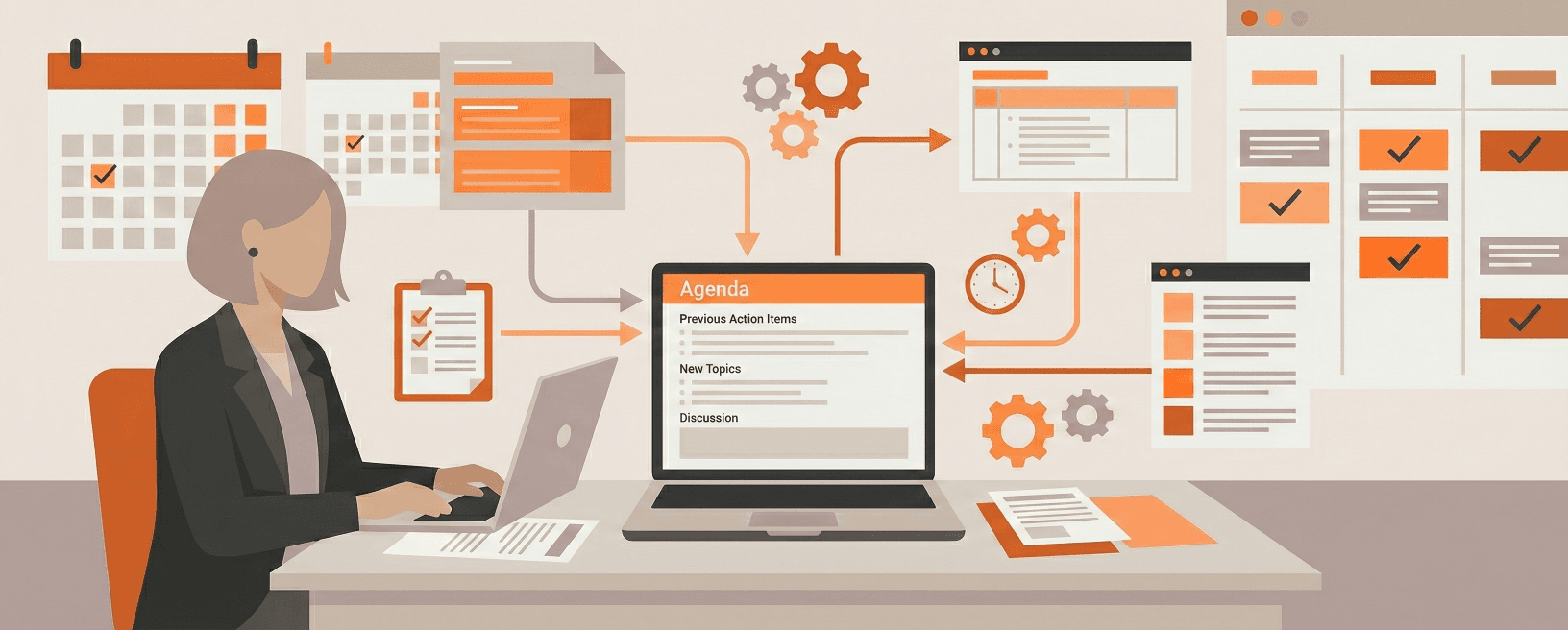
Why Agenda Creation Is Costing You More Than You Think
You schedule a team meeting, then stare at a blank agenda template wondering what actually needs discussion. You dig through Slack threads, review last week's minutes, remember half the topics at 10 PM the night before, and still end up with a vague "Project Updates" bullet that wastes 20 minutes of meeting time. The irony? You spend 30-40 minutes crafting an agenda to save time in a 60-minute meeting.
- Time saved: Reduces 30-40 minutes of agenda prep to under 5 minutes
- Consistency gain: Standardizes agenda structure across recurring meetings, ensuring critical topics never get forgotten and discussions stay focused
- Cognitive load: Eliminates the mental burden of remembering what needs discussion and tracking open items from previous sessions
- Cost comparison: Prevents productivity drain from unfocused meetings—a poorly structured 60-minute meeting with 8 people wastes $800+ in labor costs when half the time goes to unproductive tangents
This task is perfect for AI delegation because it requires information synthesis (pulling from multiple sources), pattern recognition (identifying recurring topics), and structured formatting—exactly what AI handles efficiently when given proper direction.
Here's how to delegate this effectively using the 5C Framework.
Why This Task Tests Your Delegation Skills
- Information sources (where does agenda content come from?
- Priority logic (what gets top billing versus "if time permits"?
- Output standards (what makes an agenda item actionable versus a waste of airtime?
Configuring Your AI for Meeting Agenda Creation
| 5C Component | Configuration Strategy | Why it Matters |
|---|---|---|
| Character | Meeting facilitator with corporate operations background, trained in productive meeting methodologies (Lean Coffee, structured decision-making) | Ensures AI applies facilitation best practices—time-boxing discussions, framing decisions, sequencing topics logically—not just creating lists |
| Context | Meeting cadence (weekly standup/monthly review/quarterly planning), attendees and their roles, your company's decision-making culture (consensus vs. directive) | Different meetings serve different functions—a tactical standup needs quick updates; a strategic session needs discussion prompts and pre-reads |
| Command | Generate agenda based on previous meeting outcomes, open action items, and new business; structure with time allocations and decision prompts | Prevents generic templates and ensures agendas reflect actual business needs—AI should reference what happened last time, not start from scratch |
| Constraints | Limit to 5-7 agenda items max; allocate specific minutes per topic; flag items requiring pre-work or decisions; exclude pure status updates solvable async | Stops agenda bloat and ensures meeting time focuses on discussion/decisions, not information broadcasting better handled via email |
| Content | Provide examples of strong vs. weak agenda items from your past meetings, including your preferred time allocation format and decision framing style | Teaches AI your team's conventions—whether you use parking lots, assign discussion leads, or include success criteria for each topic |
The Copy-Paste Delegation Template
<role>
You are a meeting facilitator and operations coordinator with expertise in designing productive meetings. You understand the difference between status updates (async), discussions (sync collaboration), and decisions (requiring explicit outcomes).
</role>

<context>
I need an agenda for our [meeting type: weekly team standup / monthly planning session / quarterly business review]. This meeting recurs [frequency] with [number] attendees: [list roles/names if relevant].

Our meeting standards:
- Total duration: [30/60/90 minutes]
- Decision-making style: [consensus-driven / leader decides after input / delegation model]
- We track action items in [tool/system]
- Pre-reads are [required/optional/not used]

Meeting purpose: [1-2 sentence description of what this meeting exists to accomplish]
</context>

<instructions>
Follow this sequence:

1. **Review inputs** to identify:
   - Open action items from previous meeting (what needs follow-up?)
   - Decisions pending from last session (what needs resolution?)
   - New topics introduced since last meeting (from notes, Slack, emails I provide)
   - Recurring standing items for this meeting type

2. **Prioritize topics** using this logic:
   - Time-sensitive decisions or blockers → top priority
   - Discussion items requiring group input → middle priority
   - Status updates or FYIs → lowest priority (consider moving to pre-read)
   - Items requiring pre-work → flag for advance distribution

3. **Structure each agenda item** in this format:
   - **Topic:** [Clear, specific title - max 8 words]
   - **Time:** [Minutes allocated - be realistic]
   - **Type:** [Decision / Discussion / Update / Review]
   - **Lead:** [Who drives this agenda item]
   - **Objective:** [What we need to accomplish - one sentence with success criteria]
   - **Pre-work (if applicable):** [What attendees should review/prepare beforehand]

4. **Apply meeting hygiene rules:**
   - Total agenda time should not exceed meeting duration
   - Include 5-minute buffer at end for overflow/parking lot
   - Group related topics together
   - Sequence: urgent/blocking items first, strategic discussions middle, updates last
   - If >7 items, flag which could be handled asynchronously

5. **Add structural elements:**
   - Opening (2 min): Check-in or context-setting
   - Closing (3 min): Action item recap and next steps
   - Parking lot section for off-agenda topics that emerge

Output as a formatted agenda ready to send to attendees.
</instructions>

<input>
Paste relevant inputs below:

**Previous Meeting Minutes/Notes:**
[Paste last meeting's minutes, action items, or key discussion points]

**New Topics for Discussion:**
[Paste Slack threads, email requests, or notes on what needs to be addressed]

**Standing Items (if applicable):**
[List any recurring topics for this meeting type, e.g., "Budget review" for monthly finance meetings]

Example input:
"Last week's standup notes: Sarah's Q1 report delayed pending legal review - John following up. Maria asked about Feb 5 launch timeline. New items: Engineering flagged API integration issues in #dev-chat yesterday. Finance needs approval on Q2 software budget by Friday..."

[PASTE YOUR INPUTS HERE]
</input>
The Manager's Review Protocol
- Accuracy Check: Verify all referenced action items and previous decisions match your actual records—did AI correctly interpret what's still open versus what's been completed? Confirm attendee names and time allocations reflect reality, not AI assumptions.
- Hallucination Scan: Ensure AI didn't invent topics that weren't mentioned in your inputs or create false urgency around items. Check that "Objective" statements accurately reflect the business need, not AI's speculation about why something matters. Verify any referenced dates, deadlines, or prior commitments.
- Tone Alignment: Confirm agenda language matches your team's communication culture—some teams prefer formal framing ("Review and approve Q2 budget"), others use casual shorthand ("Q2 budget - yay or nay?"). Adjust objective statements to match how your team actually talks about work.
- Strategic Fitness: Evaluate whether the agenda structure serves your meeting's actual purpose—is this the right balance of tactical vs. strategic? Are you discussing things that genuinely require synchronous collaboration, or could half these items be handled via email? Strong delegation means knowing when AI correctly prioritized versus when you need to override based on organizational context.
Build your SOP Library, one drop at a time.
We are constantly testing new ways to delegate complex work to AI. When we crack the code on a new "Job to be Done," we send the SOP directly to you, fresh from the lab.
Our Promise: High signal, low noise. We email you strictly once a week (max), and only when we have something worth your time.
When This SOP Isn't Enough
This SOP solves single-meeting agenda creation, but managers typically face meeting ecosystem optimization—coordinating agendas across multiple recurring sessions, ensuring topics flow to the right forum, and preventing duplicate discussions. The full 5C methodology covers workflow integration (connecting agenda generation to calendar management and action item tracking), custom facilitation frameworks (building meeting playbooks for different decision types), and cross-functional coordination (ensuring leadership team agendas ladder up to company priorities).
For standalone meetings, this template works perfectly. For managing interconnected meeting cadences, leadership rhythms, or org-wide communication structures, you'll need the advanced delegation frameworks taught in Sorai Academy.