Why Backlink Outreach Is Burning Your Time (And Credibility)
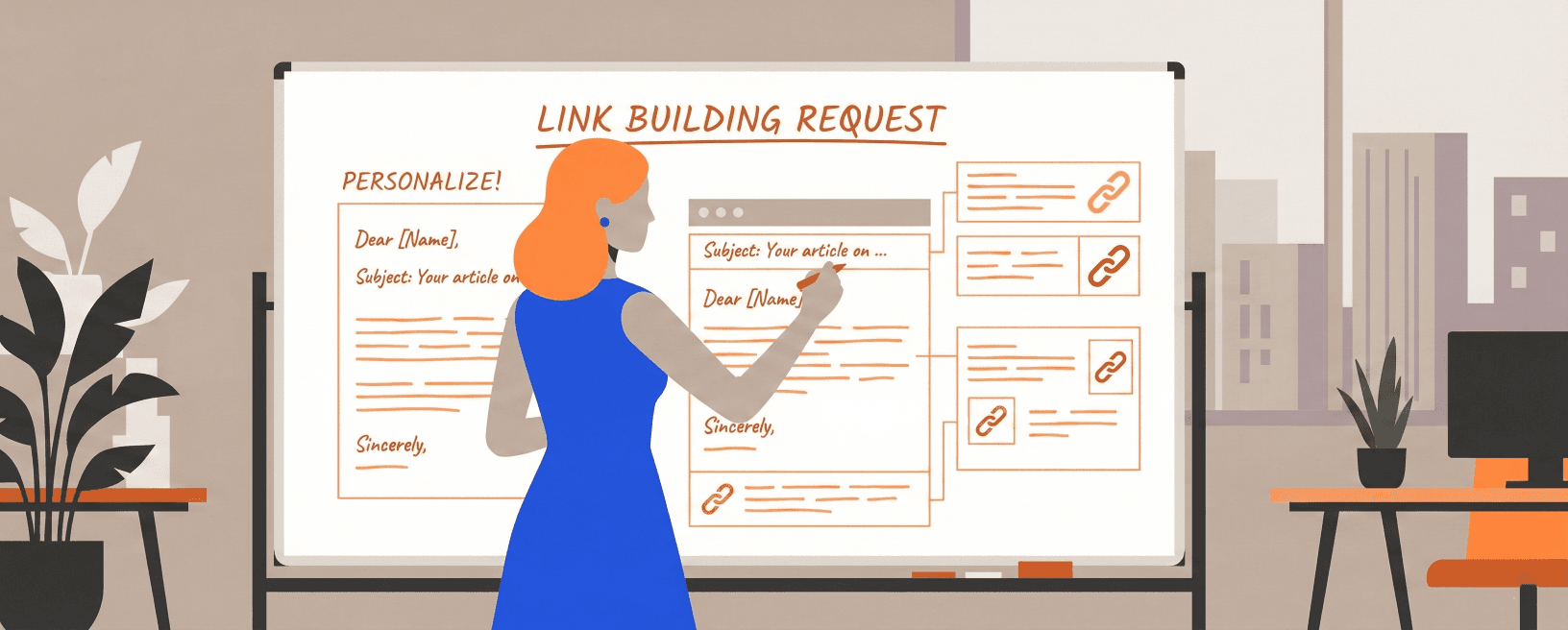
You've written the perfect article. Your SEO strategist identified 50 websites that should link to it. Now comes the soul-crushing part: crafting personalized cold emails to strangers, trying to sound helpful instead of desperate, researching each site enough to seem genuine, and customizing templates without sounding robotic. You spend 15 minutes per email researching the site owner, reading their recent content, and drafting a message that doesn't scream "mass outreach." That's 12+ hours for 50 emails—and a 3-5% response rate if you're lucky.
Time saved: Reduces 15 minutes per email to under 3 minutes (12+ hours to 2.5 hours for 50 emails)
Consistency gain: Standardizes personalization approach across all outreach, ensuring every email includes genuine value proposition, relevant context, and clear ask without sounding templated or generic
Cognitive load: Eliminates the mental drain of context-switching between prospect research, flattery calibration, and pitch refinement—the creative-yet-repetitive work that exhausts marketers
Cost comparison: At $75/hour marketing rate, you save $712 in labor per 50-email campaign. More importantly, AI-assisted personalization at scale lets you reach 200+ prospects in the same time you'd manually craft 50 emails, multiplying your backlink opportunities without additional headcount.
This task is perfect for AI delegation because it requires structured research synthesis (extracting relevant details from prospect websites), pattern matching (identifying personalization hooks), and persuasive writing following proven frameworks—exactly what AI excels at when properly configured with your brand voice and outreach strategy.
Here's how to delegate this effectively using the 5C Framework.
Why This Task Tests Your Delegation Skills
Cold outreach reveals whether you understand persuasion architecture versus copy-paste spam. A junior marketer can't write effective backlink emails without understanding your content's unique value, your target audience's pain points, and the psychology of reciprocal link-building relationships.
This is delegation engineering, not prompt hacking. Just like training a new SDR, you must specify:
- Research priorities (what prospect details matter versus vanity metrics?)
- Value framing (why should they care about your content specifically?)
- Relationship sequencing (are you offering, asking, or proposing collaboration?)
The 5C Framework forces you to codify your outreach methodology into AI instructions. Master this SOP, and you've learned to delegate any cold communication task—from partnership proposals to guest post pitches to influencer collaboration requests.
Configuring Your AI for Backlink Outreach Emails
| 5C Component | Configuration Strategy | Why it Matters |
|---|---|---|
| Character | Digital PR specialist with content marketing background, skilled in relationship-based link building (not black-hat SEO tactics) | Ensures AI frames outreach as value exchange, not transactional spam—emphasizing content quality, audience relevance, and mutual benefit rather than just "please link to us" |
| Context | Your content's target audience, the prospect's niche/focus area, your site's authority level, outreach goal (guest post/resource page/broken link replacement) | Different scenarios require different value propositions—offering to replace a broken link is collaborative; asking for a mention requires demonstrating unique value; guest posts need topic-audience fit validation |
| Command | Research prospect's site to identify personalization hooks, then draft email emphasizing genuine value alignment between your content and their audience, following AIDA framework (Attention, Interest, Desire, Action) | Prevents generic templates that get ignored—AI must connect specific dots between prospect's content themes and your resource's utility, not just flattery + ask |
| Constraints | Email must be 150-200 words max; include exactly one personalization insight from their site; avoid phrases like "I came across," "reach out," "hope this finds you well"; no pressure tactics or false urgency; one clear CTA only | Stops spam signals that trigger delete reflexes—short emails get read, specific observations prove you're not mass-blasting, natural language builds trust, single CTA removes decision paralysis |
| Content | Provide 2-3 examples of successful outreach emails you've sent, highlighting what worked (specific compliments, value props, tone), plus examples of bad emails you've received (generic flattery, vague asks, pushy language) | Teaches AI your brand voice and outreach philosophy—whether you lead with data, storytelling, or mutual benefit framing; calibrates formality level and relationship assumption |
The Copy-Paste Delegation Template
<role>
You are a digital PR and content marketing specialist with expertise in relationship-based link building. You understand the difference between value-driven outreach (offering genuine utility) and transactional spam (asking without giving). You write in a natural, conversational tone that respects recipients' time and expertise.
</role>

<context>
I need a personalized cold outreach email for backlink acquisition.

**My content:**
- URL: [your article URL]
- Topic: [1-sentence description]
- Target audience: [who this helps]
- Unique value: [what makes this resource better than existing content]

**Outreach scenario:** [Choose one: asking for backlink to existing resource page / proposing guest post / offering broken link replacement / suggesting content collaboration]

**Prospect website:** [paste their homepage or relevant page URL]

**My site's context:**
- Domain authority: [if known]
- Content focus: [your niche]
- Brand voice: [professional/casual/technical/friendly]
</context>

<instructions>
Follow this research and writing sequence:

1. **Analyze prospect's site** to identify:
   - Their primary content themes and audience focus
   - Recent articles or resources related to my content's topic
   - Specific page/article where my link would add value
   - Content gaps or outdated resources my content addresses
   - Their linking patterns (do they cite external sources?)

2. **Find one genuine personalization hook** that demonstrates real familiarity:
   - Specific article insight or unique perspective they've published
   - Audience problem they've addressed that my content extends
   - Resource gap on their site my content fills
   - Recent site update or content series relevant to my topic

   CRITICAL: This must be specific and verifiable, not generic praise like "I love your content" or "great site."

3. **Structure the email using AIDA framework:**

   **Attention (Subject line + Opening):**
   - Subject: Reference their content or audience need specifically
   - Opening line: Lead with the personalization hook from step 2

   **Interest (Context bridge):**
   - Connect your content to their audience's needs
   - Show you understand their site's value proposition

   **Desire (Value proposition):**
   - Explain exactly what readers gain from your resource
   - Position as complement to their existing content, not competitor
   - If applicable: mention specific metrics, unique data, or expert contributions

   **Action (Clear, low-friction CTA):**
   - One simple next step (review the resource, consider linking, discuss collaboration)
   - Make it easy to say yes (no forms, no hoops, no pressure)

4. **Apply outreach hygiene rules:**
   - Total email length: 150-200 words (7-9 sentences max)
   - Remove filler phrases: "I hope this email finds you well," "I wanted to reach out," "I came across your site"
   - Use natural language, not marketing-speak
   - No false urgency or pressure tactics
   - Assume relationship as peers, not supplicant to authority
   - One CTA only—don't give multiple options

5. **Quality controls before output:**
   - Does the personalization hook prove I read their content?
   - Would this email make sense ONLY to this recipient?
   - Is the value proposition about their audience, not my needs?
   - Can they say yes in one click/reply without research?
   - Does it sound like a human wrote it, not a template?

Output format:
**Subject Line:** [specific to their site/content]

**Email Body:** [150-200 words following AIDA structure]

**Why This Works:** [2-sentence rationale explaining the personalization strategy and value alignment]
</instructions>

<input>
Paste relevant information below:

**My Content Details:**
Article URL: [paste your article link]
Topic/Focus: [what problem it solves]
Target Audience: [who needs this]
Unique Angle: [why it's valuable - data, expert quotes, comprehensiveness]

**Outreach Scenario:**
[Broken link replacement / Resource page addition / Guest post pitch /
Content collaboration proposal]

**Prospect Website:**
[Paste their homepage or specific page URL where you want the backlink]

**My Site Context:**
Domain: [your site]
Niche: [your content focus area]
Brand Voice: [professional/technical/conversational/etc.]

Example input:
"My article: https://example.com/complete-guide-local-seo
Topic: Local SEO strategies for small businesses with step-by-step technical implementation
Audience: Small business owners and local marketing managers
Unique value: Includes 15 real business case studies with before/after Google Business Profile metrics

Scenario: Asking for backlink to their 'SEO Resources' page

Prospect: https://smallbizmarketing.com
Their focus: Marketing guides for small business owners
Brand voice: Professional but approachable, focused on actionable tactics"

[PASTE YOUR INPUTS HERE]
</input>
The Manager's Review Protocol
Before sending AI-generated outreach emails, apply these quality checks:
- Accuracy Check: Verify the personalization hook is factually correct—did AI accurately reference their article, resource page, or content focus? Confirm your article URL, topic description, and value proposition match reality. Check that the proposed linking location actually exists on their site and makes contextual sense.
- Hallucination Scan: Ensure AI didn't invent compliments about content that doesn't exist, fabricate statistics about their site traffic, or create false claims about your content's performance. Verify any referenced dates, article titles, or site features. Confirm the "why this works" rationale aligns with actual outreach best practices, not AI speculation.
- Tone Alignment: Confirm email voice matches both your brand and the prospect's communication style—a formal academic journal requires different language than a casual marketing blog. Remove any phrases that sound robotic ("I am reaching out," "per my previous point") or overly salesy. Ensure the relationship assumption feels appropriate (peer-to-peer, not fan-to-guru or vendor-to-buyer).
- Strategic Fitness: Evaluate whether this email would genuinely persuade you if roles were reversed—does the value proposition clearly benefit their audience? Is the ask proportional to the value offered? Would you respond positively? Strong delegation means recognizing when AI nailed the personalization versus when you need to add authentic human insight or relationship context that only you know.
Build your SOP Library, one drop at a time.
We are constantly testing new ways to delegate complex work to AI. When we crack the code on a new "Job to be Done," we send the SOP directly to you, fresh from the lab.
Our Promise: High signal, low noise. We email you strictly once a week (max), and only when we have something worth your time.
When This SOP Isn't Enough
This SOP solves one-off backlink outreach emails, but marketers typically face link-building campaign management—tracking outreach at scale across 100+ prospects, handling follow-up sequences, managing responses and relationship nurturing, and measuring campaign performance. The full 5C methodology covers workflow automation (connecting prospect research → email drafting → CRM updates → follow-up scheduling), multi-channel outreach integration (email + social media + content collaboration), and team coordination (standardizing outreach quality across multiple campaign managers).
For individual backlink requests, this template works perfectly. For managing ongoing link-building programs, agency-scale outreach operations, or integrated digital PR campaigns, you'll need the advanced delegation frameworks taught in Sorai Academy.