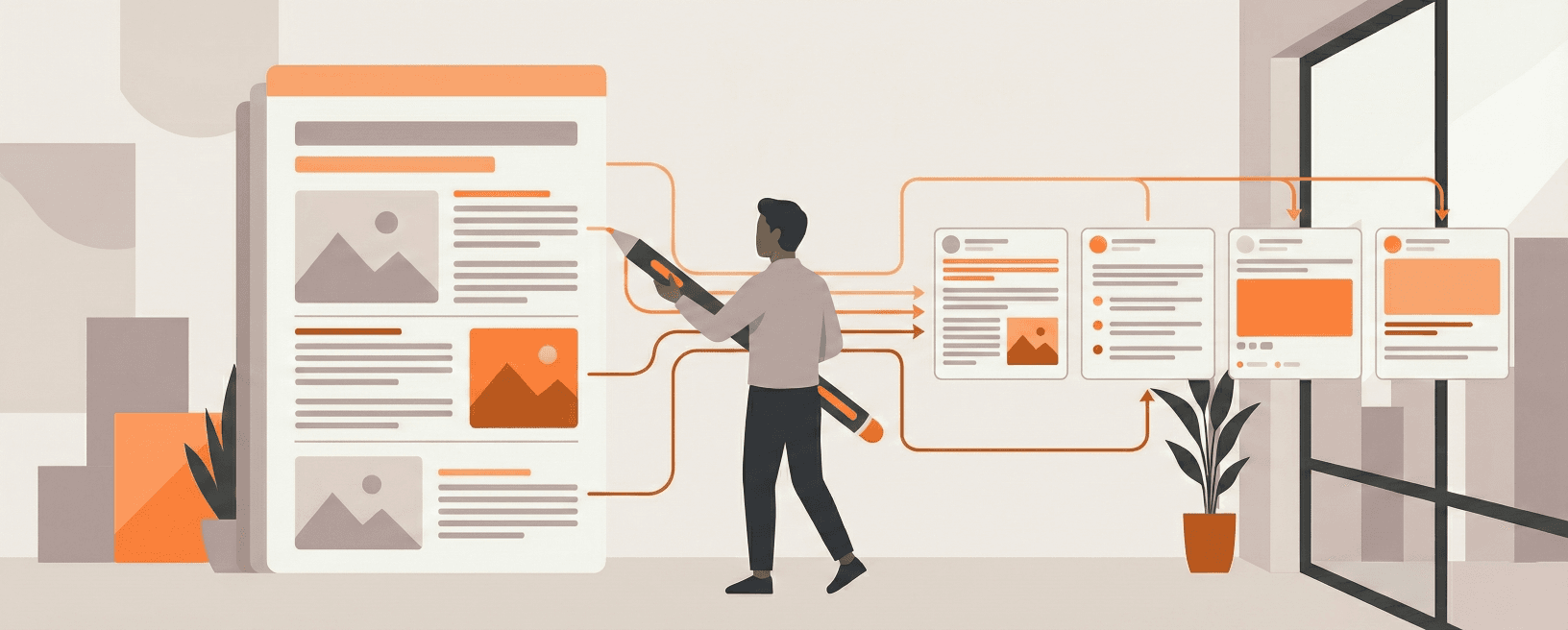
Why Manual Content Repurposing Is Killing Your Content ROI
You publish a comprehensive 2,000-word blog post, pour hours into research and writing, then face the dreaded question: "How do I promote this on LinkedIn?" You know you should create multiple posts from that single article to maximize reach, but the prospect of manually condensing, reformatting, and adapting tone for LinkedIn feels like writing the article all over again. So you post once with a generic "Check out our latest blog" caption, get minimal engagement, and watch your content investment generate a fraction of its potential value.
Time saved: Reduces 2-3 hours of manual repurposing per blog post to under 10 minutes
Consistency gain: Ensures every blog post generates 3-5 optimized LinkedIn posts rather than inconsistent one-off promotions, creating predictable content distribution workflows
Cognitive load: Eliminates the creative fatigue of "saying the same thing differently"—AI handles the translation between long-form depth and social media brevity while you focus on strategy
Cost comparison: A single blog post costs $500-2,000 to produce (whether in-house time or freelance fees). Proper repurposing multiplies ROI by 5-10x through extended reach and engagement, versus letting that investment die after one weak promotional post
This task is perfect for AI delegation because it requires format adaptation (long-form to short-form), tone translation (authoritative to conversational), and multi-angle content slicing—exactly what AI excels at when given clear parameters about your audience and brand voice.
Here's how to delegate this effectively using the 5C Framework.
Why This Task Tests Your Delegation Skills
Repurposing content reveals whether you understand distribution strategy versus simple content creation. A junior marketer can't effectively slice blog content without knowing which angles resonate with your LinkedIn audience, what hooks drive engagement in feeds versus search, and how professional social platforms differ from casual ones.
This is delegation engineering, not prompt hacking. Just like briefing a social media coordinator, you must specify:
- Audience context (who follows you on LinkedIn versus who reads your blog?)
- Engagement mechanics (what makes people stop scrolling and click?)
- Brand positioning (how formal/casual is your company voice on social platforms?)
The 5C Framework forces you to codify these strategic decisions into AI instructions. Master this SOP, and you've learned to delegate any cross-platform content adaptation task—from webinar recordings to newsletter snippets to podcast show notes.
Configuring Your AI for Blog-to-LinkedIn Repurposing
| 5C Component | Configuration Strategy | Why it Matters |
|---|---|---|
| Character | Social media strategist specializing in B2B LinkedIn content, with expertise in platform algorithms, engagement psychology, and professional audience behavior | Ensures AI applies LinkedIn-specific best practices—hook formulas, scroll-stopping openings, conversation starters—not generic social media tactics that work on Instagram but fail on LinkedIn |
| Context | Your target LinkedIn audience (job titles, pain points, content preferences), your company's brand voice on social platforms, typical engagement patterns on your posts, blog content topic and key insights | Different audiences consume content differently—a post for CTOs needs technical credibility; a post for marketing directors needs business impact framing. AI must understand who it's writing for, not just what it's summarizing |
| Command | Extract 3-5 distinct angles from the blog post, create standalone LinkedIn posts for each angle with hooks optimized for feed visibility, maintain narrative coherence while making each post independently valuable | Prevents lazy summarization and ensures each post delivers standalone value—readers shouldn't need to click through to understand the core insight, but should want to read more |
| Constraints | LinkedIn post length guidelines (1,300 characters for optimal visibility), no clickbait or sensationalism, maintain professional credibility, include clear CTAs, avoid repetitive hooks across multiple posts from same source | Stops AI from creating 5 posts that all start with "Did you know..." or violating LinkedIn's unwritten rules about what feels authentic versus promotional spam |
| Content | Provide examples of your best-performing LinkedIn posts (successful hooks, engagement drivers, tone), your company's voice guidelines, and 2-3 angles you typically emphasize (tactical how-to vs. strategic insights vs. contrarian takes) | Teaches AI your brand's personality—whether you lead with data, storytelling, provocative questions, or practical frameworks—so output feels authentically yours |
The Copy-Paste Delegation Template
<role>
You are a B2B social media strategist specializing in LinkedIn content optimization. You understand LinkedIn's algorithm (prioritizes
conversation-starting content, values dwell time over clicks), audience psychology (professionals seeking actionable insights and
peer validation), and the platform's unwritten norms (authentic over promotional, specific over vague, conversational over corporate).
</role>

<context>
I need to repurpose a blog post into multiple LinkedIn posts that maximize reach and engagement on my company profile and personal account.

Our LinkedIn audience:
- Primary roles: [e.g., "Marketing directors and VPs at B2B SaaS companies, 50-500 employees"]
- Pain points they follow us for: [e.g., "Scaling marketing without proportional budget increases, proving ROI, team productivity"]
- Engagement patterns: [e.g., "Respond well to frameworks and checklists, prefer actionable over theoretical, comment most on
  posts asking for their experiences"]

Our brand voice on LinkedIn:
- Tone: [e.g., "Conversational but credible—friendly expert, not stuffy corporate or overly casual"]
- Perspective: [e.g., "We're practitioners sharing what works, not consultants theorizing"]
- Style preferences: [e.g., "Use line breaks for readability, include emojis sparingly (1-2 per post), ask questions to drive comments"]

Blog post details:
- Topic: [Brief description]
- Key insights: [3-5 main takeaways from the article]
- Target action: [What you want readers to do—read full post, download resource, join waitlist, etc.]
</context>

<instructions>
Follow this sequence:

1. **Analyze the blog post** to identify:
   - The central thesis or argument
   - 5-7 distinct angles or sub-topics that could stand alone
   - Surprising insights, contrarian points, or "aha moments"
   - Practical frameworks, checklists, or how-to components
   - Data points, case studies, or concrete examples

2. **Select 3-5 angles** that will resonate most with the LinkedIn
   audience, prioritizing:
   - Content that sparks discussion (asks questions, challenges assumptions)
   - Actionable insights readers can apply immediately
   - Contrarian or surprising perspectives that stand out in feeds
   - Framework-based content that's easy to screenshot and save

3. **Craft each LinkedIn post** using this structure:
   - **Hook (first 1-2 lines):** Scroll-stopping opening that creates curiosity, challenges conventional wisdom, or promises specific
     value. Must work BEFORE "see more" cutoff (~140 characters).
   - **Core insight (middle section):** Deliver on the hook's promise with specific details, frameworks, or examples from the blog. Use line breaks for scanability. Make this valuable even if reader doesn't click through.
   - **Engagement driver:** Include element that encourages comments (question, "what's worked for you?", invitation to share experiences)
   - **CTA:** Clear next step tied to blog post, feels natural not forced

4. **Optimize for LinkedIn algorithm:**
   - Keep posts under 1,300 characters for full visibility without "see more"
   - Front-load value—don't bury the insight
   - Use 2-3 relevant hashtags (not more)
   - Include line breaks between paragraphs (2-3 line blocks maximum)
   - Avoid external links in post body (kills reach)—put link in first comment

5. **Ensure post independence:**
   - Each post should deliver complete value without requiring blog click-through
   - Avoid repetitive openings across the 3-5 posts
   - Vary the content type (tactical tip vs. strategic insight vs. contrarian take)
   - Make each post feel fresh, not like rehashed versions of each other

Output each post in this format:

**POST [X]: [Angle description]**
**Best for:** [Personal profile / Company page / Both]
**Hook type:** [Question / Contrarian / Framework / Case study]

[Full post text]

**First comment:** [Link to blog post with brief additional context]

---

[Repeat for each post]
</instructions>

<input>
Paste your blog post content below:

**Blog Title:** [Your blog post title]

**Blog URL:** [Link to the published post]

**Full Blog Text:**
[Paste the complete blog post text here, including headings, subheadings, and key data points]

Example input:
"Blog Title: The Hidden Cost of Manual Data Entry in Sales Teams

Blog URL: https://example.com/blog/manual-data-entry-costs

Full Blog Text:
Sales leaders obsess over close rates and pipeline velocity, but there's a silent productivity killer lurking in every CRM: manual
data entry. Our analysis of 200 sales teams found that reps spend an average of 4.2 hours per week entering data that could be automated...

[Continue with full blog text]"

[PASTE YOUR BLOG CONTENT HERE]
</input>
The Manager's Review Protocol
Before publishing AI-generated LinkedIn posts, apply these quality checks:
- Accuracy Check: Verify that all statistics, frameworks, and claims from the blog post are correctly represented—did AI preserve nuance or oversimplify to the point of inaccuracy? Confirm any numerical data matches the source exactly. Check that technical terminology is used correctly for your industry's standards.
- Hallucination Scan: Ensure AI didn't invent insights that weren't in the original blog post or exaggerate claims beyond what you actually stated. Watch for AI adding its own "helpful" context that wasn't part of your original argument. Verify that case studies or examples came from your blog, not AI's imagination.
- Tone Alignment: Confirm each post sounds like your brand voice—does it match how you actually communicate on LinkedIn? Check that formality level fits your audience (avoid overly casual for enterprise B2B, or stiff corporate-speak for creative industries). Verify that calls-to-action feel natural rather than salesy or forced.
- Strategic Fitness: Evaluate whether the selected angles actually serve your marketing goals—are these the messages that drive your business objectives, or just the easiest things to extract? Assess whether posts create genuine engagement opportunities or just broadcast information. Strong delegation means recognizing when AI chose convenient angles versus strategically valuable ones that build authority and generate qualified leads.
Build your SOP Library, one drop at a time.
We are constantly testing new ways to delegate complex work to AI. When we crack the code on a new "Job to be Done," we send the SOP directly to you, fresh from the lab.
Our Promise: High signal, low noise. We email you strictly once a week (max), and only when we have something worth your time.
When This SOP Isn't Enough
This SOP solves single blog-to-LinkedIn repurposing, but marketing teams typically face omnichannel content distribution—adapting blog content for LinkedIn, Twitter, email newsletters, YouTube community posts, and sales enablement materials simultaneously. The full 5C methodology covers content workflow orchestration (one source asset generating 15+ derivative pieces), platform-specific optimization frameworks (understanding what works where and why), and team-scale content operations (training multiple marketers to delegate consistently).
For repurposing one blog post to LinkedIn, this template works perfectly. For building systematic content distribution engines that maximize every piece of content across all channels, you'll need the advanced delegation frameworks taught in Sorai Academy.