Why Generic Auto-Responders Are Costing You Opportunities
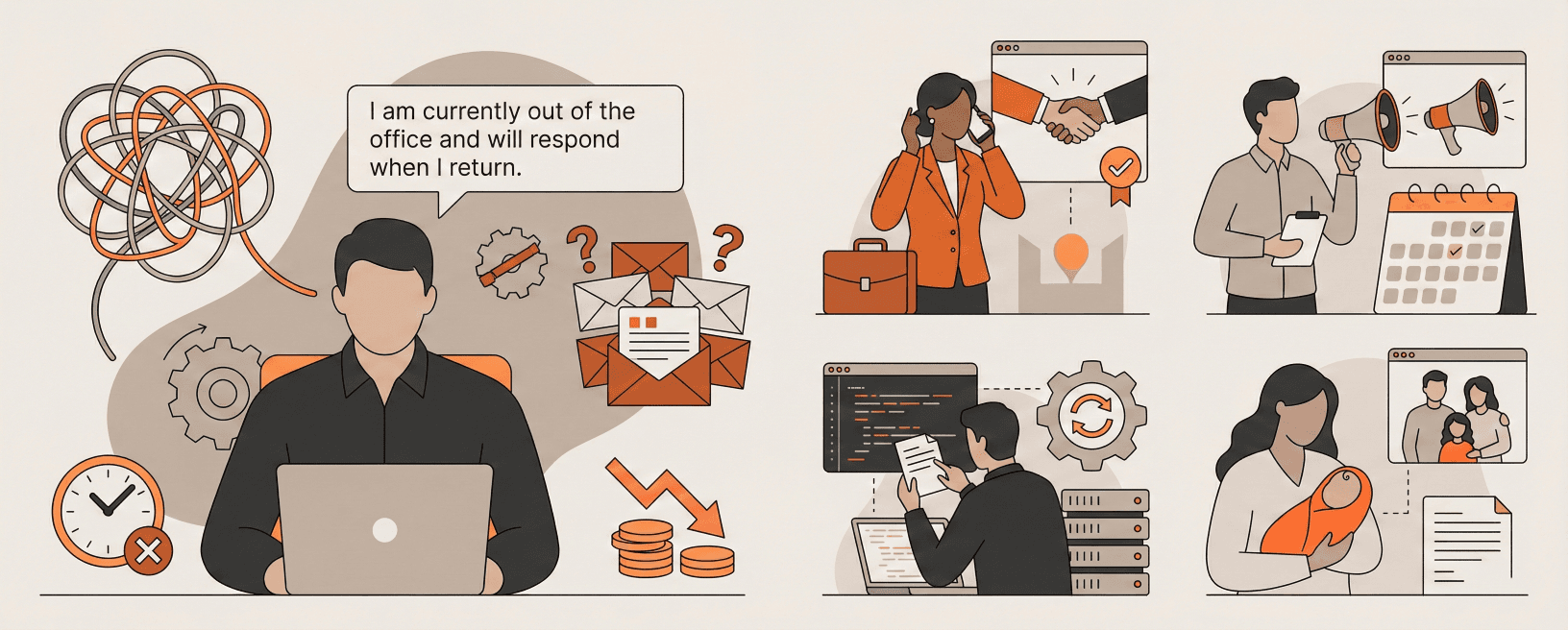
You're heading out for vacation, parental leave, or a conference, so you open your email settings and type: "I am currently out of the office and will respond when I return." Simple, right? Except clients see this before a pitch meeting and wonder if they should reschedule. Urgent vendor issues go unrouted because you didn't specify who handles what. Your team doesn't know whether to wait for you or escalate. That generic three-line message just created confusion, delayed decisions, and potentially lost revenue.
Time saved: Reduces 15-20 minutes of drafting context-specific responses to under 2 minutes
Consistency gain: Standardizes professional communication during absences, ensuring every stakeholder type receives appropriate guidance instead of one-size-fits-none messages
Cognitive load: Eliminates the mental burden of remembering who needs what information and how to phrase handoff protocols professionally
Cost comparison: Prevents business disruption—a vague OOO message that delays a $50K deal closure or causes a client to reach out to competitors costs exponentially more than the time to write a proper response
This task is perfect for AI delegation because it requires situational customization (different messages for clients vs. colleagues), professional tone calibration, and comprehensive handoff logic—exactly what AI handles efficiently when given proper context about your role and responsibilities.
Here's how to delegate this effectively using the 5C Framework.
Why This Task Tests Your Delegation Skills
Crafting out-of-office responses reveals whether you understand communication architecture versus message writing. An effective auto-responder isn't just polite words—it's a routing system that ensures business continuity when you're unavailable.
This is delegation engineering, not prompt hacking. Just like briefing a receptionist covering your desk, you must specify:
- Audience segmentation (who gets what information?)
- Escalation protocols (which issues require immediate attention vs. can wait?)
- Tone calibration (how formal/casual based on relationship dynamics?)
The 5C Framework forces you to codify these communication principles into AI instructions. Master this SOP, and you've learned to delegate any stakeholder communication task—from customer service templates to crisis response messaging to onboarding sequences.
Configuring Your AI for Out-of-Office Messages
| 5C Component | Configuration Strategy | Why it Matters |
|---|---|---|
| Character | Corporate communications specialist with expertise in professional correspondence and stakeholder management | Ensures AI understands communication nuance—knowing when to sound warm vs. formal, how to redirect without creating panic, and how to maintain relationship equity during your absence |
| Context | Your role and responsibilities, absence reason and duration, who covers what during your absence, urgency thresholds for different stakeholder types | Different absences need different messaging—a two-day conference requires light coverage details; parental leave needs comprehensive handoff protocols; executive-level absences require reassurance to maintain client confidence |
| Command | Generate role-appropriate OOO messages that segment by sender type, provide specific alternate contacts with context, set expectations for response timing, and maintain professional relationship tone | Prevents generic messages that frustrate recipients—a client expecting a proposal needs different information than an internal team member asking about expense approvals |
| Constraints | Never promise specific response dates you can't guarantee; avoid oversharing personal absence details; ensure backup contacts have actually agreed to coverage; maintain confidentiality about sensitive projects | Stops AI from creating liability—promising "I'll respond Monday" when you return Friday creates broken expectations, and mentioning confidential work in auto-responders violates operational security |
| Content | Provide examples of effective OOO messages from your organization, including your preferred balance of warmth/professionalism and how much detail to share about coverage | Teaches AI your company's communication culture—some orgs prefer minimal "back [date]" messages, others expect detailed routing trees; some industries require formal language, others value personable warmth |
The Copy-Paste Delegation Template
<role>
You are a corporate communications specialist with expertise in professional correspondence and business continuity planning. You understand how out-of-office messages impact client relationships, internal workflow, and professional perception.
</role>

<context>
I need out-of-office auto-responder messages for an upcoming absence.

My role details:
- Job title/function: [Your role - e.g., "Director of Sales Operations"]
- Key responsibilities: [What you normally handle - e.g., "Client contracts, vendor negotiations, team approvals"]
- Typical senders: [Who emails you - e.g., "Enterprise clients, internal sales team, vendors, leadership"]

Absence details:
- Dates: [Start date] through [Return date]
- Reason (if sharing): [Vacation / Conference / Parental leave / Medical leave / etc.]
- Return schedule: [Full return immediately / Limited availability first week / Gradual ramp]

Coverage arrangements:
- For [type of inquiry]: Contact [Name, Title, Email] - [What they can help with]
- For [type of inquiry]: Contact [Name, Title, Email] - [What they can help with]
- Urgent/escalation: [Name, Title, Email] - [Criteria for what qualifies as urgent]

Communication preferences:
- Tone: [Warm and approachable / Professional and formal / Industry-specific style]
- Detail level: [Minimal / Comprehensive routing / Somewhere between]
- Check email during absence: [Yes, but limited / Emergency only / Completely offline]
</context>

<instructions>
Follow this sequence:

1. **Analyze audience segments** to create targeted messages for:
   - External clients/customers (maintain relationship confidence)
   - Internal team members (ensure workflow continuity)
   - Vendors/partners (provide transaction-specific routing)
   - General/unknown senders (professional catch-all)
   - VIP/executive stakeholders (may need personalized version)

2. **Structure each message variant** with these components:
   - **Opening:** Professional acknowledgment with absence dates
   - **Context (if appropriate):** Brief, professional reason without oversharing
   - **Routing guidance:** Specific alternate contacts with clear criteria for who handles what
   - **Expectation setting:** When/whether you'll check email, response timeline upon return
   - **Relationship maintenance:** Appropriate warmth without undermining coverage contacts

3. **Apply message architecture principles:**
   - Lead with most critical information (dates, who to contact)
   - Segment contacts by sender capability—if you can identify sender type, route appropriately
   - Provide decision criteria: "For urgent contract questions contact X; for general inquiries contact Y"
   - Avoid creating false urgency or suggesting delays that don't exist
   - Include your return date and set realistic response expectations

4. **Create output variants:**

   **Variant A: External Clients/Customers**
   [Message optimized for relationship maintenance and seamless handoff]

   **Variant B: Internal Team**
   [Message with workflow continuity details and appropriate coverage]

   **Variant C: General/Default**
   [Professional catch-all for unidentified senders]

   **Variant D: VIP/Executive (optional)**
   [If certain stakeholders need personalized attention]

5. **Quality controls:**
   - Verify all contact names, titles, and emails are accurate
   - Ensure coverage contacts have agreed to handle specified requests
   - Check that tone matches your professional brand and company culture
   - Confirm no confidential project details or personal information are exposed
   - Validate that routing logic doesn't create coverage gaps or confusion

Output as email-ready text blocks labeled by audience segment.
</instructions>

<input>
Provide your absence and coverage details:

Example format:
"I'm the VP of Product and will be out Aug 1-15 for parental leave. I normally handle product roadmap decisions, feature prioritization, and stakeholder updates. During my absence:
- Product questions: Sarah Chen (Product Director, sarah@company.com)
- Urgent escalations: Mike Rodriguez (CPO, mike@company.com)
- General team questions: Hold until I return
I won't be checking email. Back full-time Aug 16."

[PASTE YOUR ABSENCE DETAILS HERE]
</input>
The Manager's Review Protocol
Before activating AI-generated out-of-office messages, apply these quality checks:
- Accuracy Check: Verify all alternate contact information is correct—names, titles, and email addresses must be accurate to prevent misdirected urgent requests. Confirm that coverage responsibilities match what backup contacts actually agreed to handle. Double-check dates, especially if crossing month boundaries or dealing with international date formats.
- Hallucination Scan: Ensure AI didn't invent coverage arrangements you didn't specify or create routing protocols that don't exist in your organization. Verify the message doesn't promise response capabilities you can't deliver (like "I'll check email daily" when you're actually offline). Check that any mentioned projects or initiatives are real and appropriately public information.
- Tone Alignment: Confirm the messaging style matches your professional brand and relationship dynamics—are you appropriately warm with long-term clients while maintaining professionalism? Does the formality level match your industry and company culture? Verify the message doesn't sound dismissive ("I'm unavailable") or overly apologetic ("So sorry for the inconvenience") when a straightforward handoff is appropriate.
- Strategic Fitness: Evaluate whether the message architecture actually enables business continuity—will recipients know exactly who to contact for their specific need, or will they send scatter-shot emails to everyone mentioned? Does the routing logic prevent bottlenecks (like directing everything to one overwhelmed backup)? Strong delegation means knowing when AI's logical coverage structure misses political or relationship dynamics only you understand.
Build your SOP Library, one drop at a time.
We are constantly testing new ways to delegate complex work to AI. When we crack the code on a new "Job to be Done," we send the SOP directly to you, fresh from the lab.
Our Promise: High signal, low noise. We email you strictly once a week (max), and only when we have something worth your time.
When This SOP Isn't Enough
This SOP solves individual absence communication, but managers typically face comprehensive coverage planning—coordinating handoffs across multiple team members, maintaining service level agreements during planned absences, and ensuring institutional knowledge doesn't create single points of failure. The full 5C methodology covers workflow documentation (building coverage playbooks that reduce OOO complexity), team cross-training protocols (ensuring multiple people can handle critical functions), and systematic communication management (creating templates for different absence scenarios across your organization).
For personal out-of-office needs, this template works perfectly. For managing department-wide coverage programs, executive succession planning, or enterprise business continuity, you'll need the advanced delegation frameworks taught in Sorai Academy.