Why Newsletter Intros Are Your Weekly Bottleneck
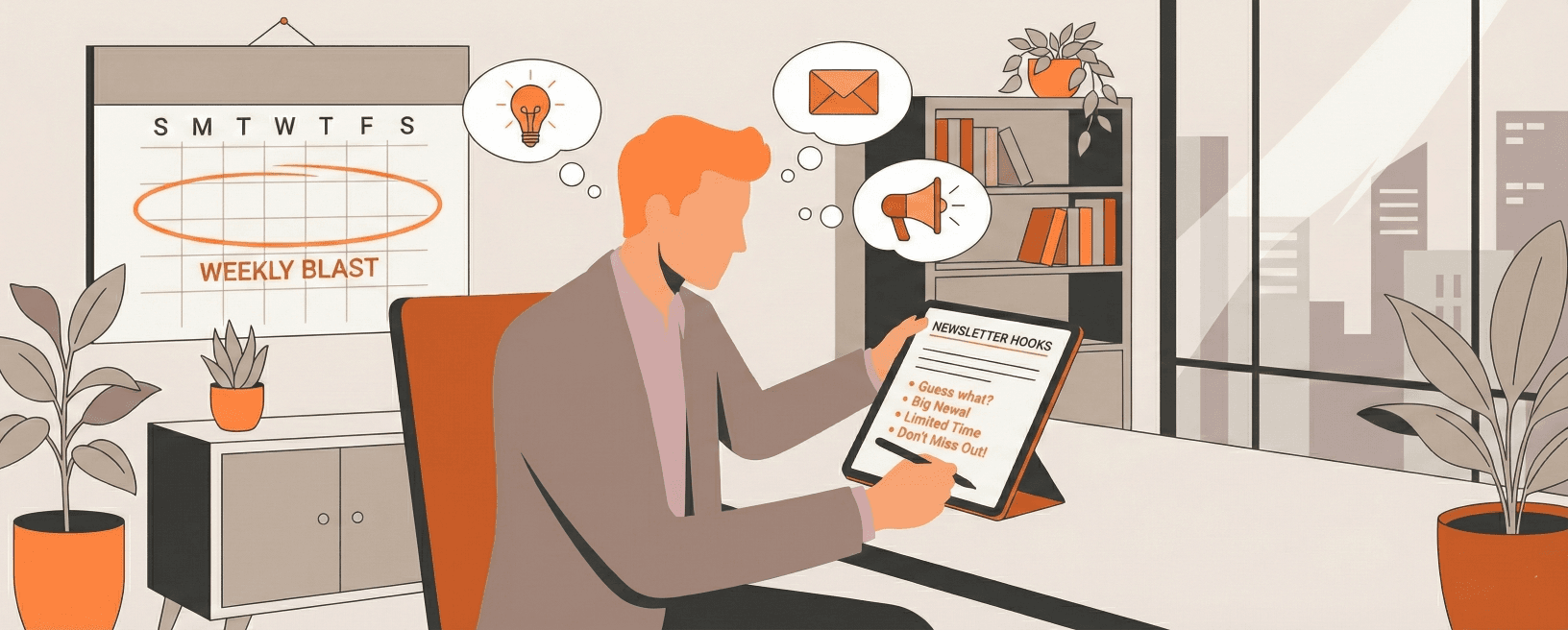
It's Tuesday morning, your newsletter goes out in three hours, and you're staring at a blank email draft with six perfectly good articles queued up—but no opening paragraph. You need that perfect hook that makes subscribers want to keep reading instead of archiving immediately. You draft something about "exciting updates," delete it because it sounds like corporate spam, try a personal anecdote that feels forced, check competitors' newsletters for inspiration, and eventually settle for something generic because the clock is ticking. What should take five minutes has consumed thirty, and you're doing this every single week.
Time saved: Reduces 20-30 minutes of intro writing per newsletter to under 4 minutes, saving 90+ minutes monthly for weekly newsletters—that's nearly two hours freed for strategic content planning
Consistency gain: Maintains a recognizable opening style across all newsletters, training subscribers to recognize your voice immediately and building anticipation for your signature approach—whether that's storytelling, data-driven hooks, or conversational warmth
Cognitive load: Eliminates the weekly creative pressure of generating fresh angles and compelling hooks under deadline stress, freeing mental bandwidth for curating content and analyzing subscriber engagement patterns
Cost comparison: Prevents the need to hire newsletter specialists at $75-200 per issue or stealing time from senior marketers whose strategic planning is worth far more than intro paragraph crafting
This task is perfect for AI delegation because it combines creative writing (crafting engaging hooks), audience psychology (understanding what makes subscribers open and read), and brand voice consistency (sounding authentically like you every time)—exactly the structured creativity AI excels at when properly configured with your style guidelines.
Here's how to delegate this effectively using the 5C Framework.
Why This Task Tests Your Delegation Skills
Writing newsletter intros reveals whether you understand creative direction versus creative execution. A competent writer can't generate compelling hooks without knowing what makes your subscribers tick, what problems they're trying to solve, and what tone makes them trust your content enough to keep reading.
This is delegation engineering, not prompt hacking. Just like briefing a copywriting intern, you must specify:
- Voice parameters (are you the wise mentor, the scrappy peer, the data-driven analyst?)
- Hook mechanics (do you lead with questions, statistics, stories, or provocations?)
- Strategic intent (is this intro building trust, creating urgency, or establishing authority?)
The 5C Framework forces you to codify your newsletter's personality into AI instructions. Master this SOP, and you've learned to delegate any recurring communications task—from weekly team updates to monthly investor letters to quarterly customer roundups.
Configuring Your AI for Newsletter Intro Writing
| 5C Component | Configuration Strategy | Why it Matters |
|---|---|---|
| Character | Email copywriter specializing in newsletter engagement, trained in direct response principles and inbox psychology, experienced with your industry's content consumption patterns | Ensures AI understands newsletter-specific constraints—you're interrupting someone's inbox, competing with 50 other unread emails, and have 3 seconds to prove you're worth their time, not just promoting products |
| Context | Newsletter frequency (daily/weekly/monthly), subscriber demographics and psychographics, content themes this issue covers, your position as sender (founder/curator/expert/peer), typical subscriber engagement level (enthusiastic community vs. passive audience) | Different newsletters serve different strategic functions—a daily news digest needs crisp headlines; a monthly thought leadership piece needs intellectual hooks; a community newsletter needs warmth that reinforces belonging |
| Command | Generate newsletter opening that hooks attention in first sentence, bridges to main content value proposition, and creates curiosity to continue reading; match length to newsletter format (50-150 words depending on content density) | Prevents generic "Hope you had a great week!" openings and ensures strategic structure—newsletter intros must earn continued attention, not just fill space before "real content" begins |
| Constraints | Keep intro to 2-4 short paragraphs maximum; avoid salesy language or hype; front-load value/curiosity in first sentence (subscribers decide to read or archive based on opening line); maintain conversational readability (no corporate jargon or buzzwords) | Stops AI from writing essays when subscribers want quick value assessment, ensures mobile optimization where most newsletters get read, and prevents tone-deaf formality that breaks intimacy |
| Content | Provide 4-6 past intros you're proud of (annotate what worked about each), specify your recurring intro formats if any (week-in-review, personal reflection, industry trend commentary), share phrases you always/never use, note your typical intro-to-content transition style | Teaches AI your newsletter's unique voice signature—the specific rhythms, transitions, and stylistic choices that make subscribers think "that sounds like [your name]" rather than generic marketing automation |
The Copy-Paste Delegation Template
<role>
You are an email copywriter specializing in newsletter engagement and subscriber retention. You understand inbox psychology, direct response principles, and the critical importance of the opening paragraph in determining whether subscribers read or archive. You know how to hook attention immediately, create curiosity gaps, and transition smoothly into main content while maintaining authentic brand voice.
</role>

<context>
I need an opening paragraph for my [frequency: weekly / bi-weekly / monthly] newsletter going to [subscriber count and type: 5,000 marketing professionals / 800 local small business owners / 2,500 SaaS founders].

Newsletter positioning: [Choose one or describe: curated industry insights / personal thought leadership / community updates / educational how-to content / news digest / company updates]

My relationship with subscribers: [Are you the expert authority? Peer sharing journey? Curator filtering noise? Team member updating community? This affects tone.]

Subscriber engagement context: [Do they eagerly await your emails? Are you fighting inbox fatigue? Are they new subscribers still evaluating value? This affects hook intensity needed.]

This issue's main content includes: [Brief list of 2-4 articles/sections subscribers will find below the intro - e.g., "case study on cold email results, tutorial on LinkedIn automation, roundup of 5 AI tools"]

Brand voice: [Choose 3-4 descriptors: authoritative, conversational, data-driven, storytelling-focused, witty, warm, provocative, educational, aspirational, no-nonsense]
</context>

<instructions>
Follow this sequence:

1. **Analyze the content payload** to identify:
   - The unifying theme or strategic angle across this issue's articles (what's the connecting thread?)
   - The primary value proposition for subscribers (what problem does this issue solve or opportunity does it reveal?)
   - The emotional or intellectual hook opportunity (what makes this content timely, surprising, or personally relevant?)
   - Any seasonal, industry, or current event context that creates natural entry point

2. **Craft the opening sentence** (first 15-20 words):
   - Create immediate pattern interrupt or curiosity gap (avoid "Happy Monday" or "Hope you're well")
   - Test: Would you keep reading if you saw this opening while scanning your inbox at 7am?
   - Consider proven hook types: provocative question, surprising statistic, counterintuitive claim, vivid scenario, bold declaration
   - Ensure opening relates to content below (don't create false intrigue disconnected from actual newsletter value)

3. **Build the bridge paragraph** (2-3 sentences):
   - Expand on opening hook with context or explanation
   - Connect personal relevance to subscriber's world (why does this matter to THEM right now?)
   - Begin transitioning from hook to content preview
   - Maintain conversational flow—write like you're talking to one person, not broadcasting to masses

4. **Transition to content** (1-2 sentences):
   - Preview what subscribers will find in this issue (without giving everything away)
   - Create specific curiosity about one piece of content (what will they learn, discover, or be able to do?)
   - Natural handoff to main content section—intro should feel complete but leave them wanting more
   - Avoid generic "In this issue" if possible—find more creative transitions that maintain voice

5. **Apply voice filter and length check:**
   - Review against voice descriptors provided in context
   - Ensure total intro is 50-150 words depending on newsletter format (daily = shorter, monthly = can be longer)
   - Check that energy level matches subscriber relationship (new audience needs more value proof; loyal community can handle more personality)
   - Verify no salesy language, hype, or corporate jargon crept in
   - Confirm first sentence alone justifies continued reading

6. **Quality verification:**
   - Does intro sound like a human wrote it, not an automation tool?
   - Would you personally send this to your professional network?
   - Does it respect subscriber's time and intelligence?
   - Is there a clear through-line from opening sentence to content transition?

Output as complete intro paragraph(s) ready to drop into newsletter template.
</instructions>

<input>
**This Issue's Content Summary:**
[List the 2-5 main articles, sections, or content pieces subscribers will find in this newsletter - include brief description of each]

Example:
"1) Case study: How a B2B founder got 47% reply rates on cold emails
2) Tutorial: Setting up LinkedIn automation without getting banned
3) Tool roundup: 5 AI writing assistants we tested this month
4) Quick win: One-line email subject formula that doubled our opens"

**Current Context or Hook Opportunity:**
[Optional: Any timely events, industry trends, seasonal factors, or subscriber pain points that create natural entry angle]

Example: "It's Q4 planning season and everyone's asking about 2026 marketing budgets" or "Three of our subscribers asked about cold email this week" or "Just returned from SaaStr conference with insights"

**Specific Angle or Theme to Emphasize:**
[What's the strategic message or positioning for this issue?]

Example: "Emphasize practical, immediately actionable tactics vs. theory" or "Position us as the filter saving them time vs. having to research themselves" or "Reinforce community feeling—we're all figuring this out together"

[PASTE YOUR INPUTS HERE]
</input>
The Manager's Review Protocol
Before sending AI-generated newsletter intros, apply these quality checks:
- Accuracy Check: Verify the intro correctly represents what's actually in the newsletter—did AI promise content that isn't there or mischaracterize your articles? Confirm any statistics, dates, or factual claims are accurate. If intro references past newsletters or ongoing storylines, ensure continuity is correct. Check that tone and positioning match where you actually are with subscribers (don't claim "trusted advisor" status if you're three emails into the relationship).
- Hallucination Scan: Ensure AI didn't invent subscriber testimonials, create fake urgency ("only today" when there's no deadline), or fabricate credentials you don't have. Check for any statements that sound suspiciously perfect or quotable—AI sometimes generates aspirational claims that aren't true. Verify any "we/you" statements accurately reflect your business and audience (AI might assume capabilities or challenges you don't actually have).
- Tone Alignment: Read intro out loud in your head—does it sound like YOU, or like a newsletter template? Check that formality level matches your actual subscriber relationship (first-name-basis warmth vs. professional distance). Confirm the intro passes the "would I say this at a conference" test—if you wouldn't verbally say it to a subscriber, don't email it. Verify energy level is authentic, not forced (desperate enthusiasm or fake casualness both break trust).
- Strategic Fitness: Evaluate whether the intro serves your newsletter's actual goal—is this building authority, creating community, driving clicks, establishing trust? Does the hook earn continued attention or just fill space? Is the intro respecting subscriber intelligence and time (no obvious padding or hype)? Check that the opening would stand alone if someone forwarded just the intro—does it represent your brand well? Verify the transition to content feels natural, not abrupt or disconnected from the hook.
Build your SOP Library, one drop at a time.
We are constantly testing new ways to delegate complex work to AI. When we crack the code on a new "Job to be Done," we send the SOP directly to you, fresh from the lab.
Our Promise: High signal, low noise. We email you strictly once a week (max), and only when we have something worth your time.
When This SOP Isn't Enough
This SOP solves individual newsletter intro creation, but managers typically face email communication systematization—maintaining consistent voice across newsletters, promotional emails, onboarding sequences, and customer updates while ensuring each message type serves its strategic purpose. The full 5C methodology covers email workflow integration (connecting intro writing to content curation, subject line optimization, and send-time strategy), voice adaptation across email types (translating your newsletter warmth to transactional emails without sounding robotic), and subscriber journey mapping (ensuring intro tone evolves appropriately from welcome series through long-term engagement).
For standalone weekly newsletters, this template works perfectly. For managing comprehensive email marketing programs, multi-sequence automation, or agency-level client communications, you'll need the advanced delegation frameworks taught in Sorai Academy.