Why Manual Event Planning Is Inviting Disaster
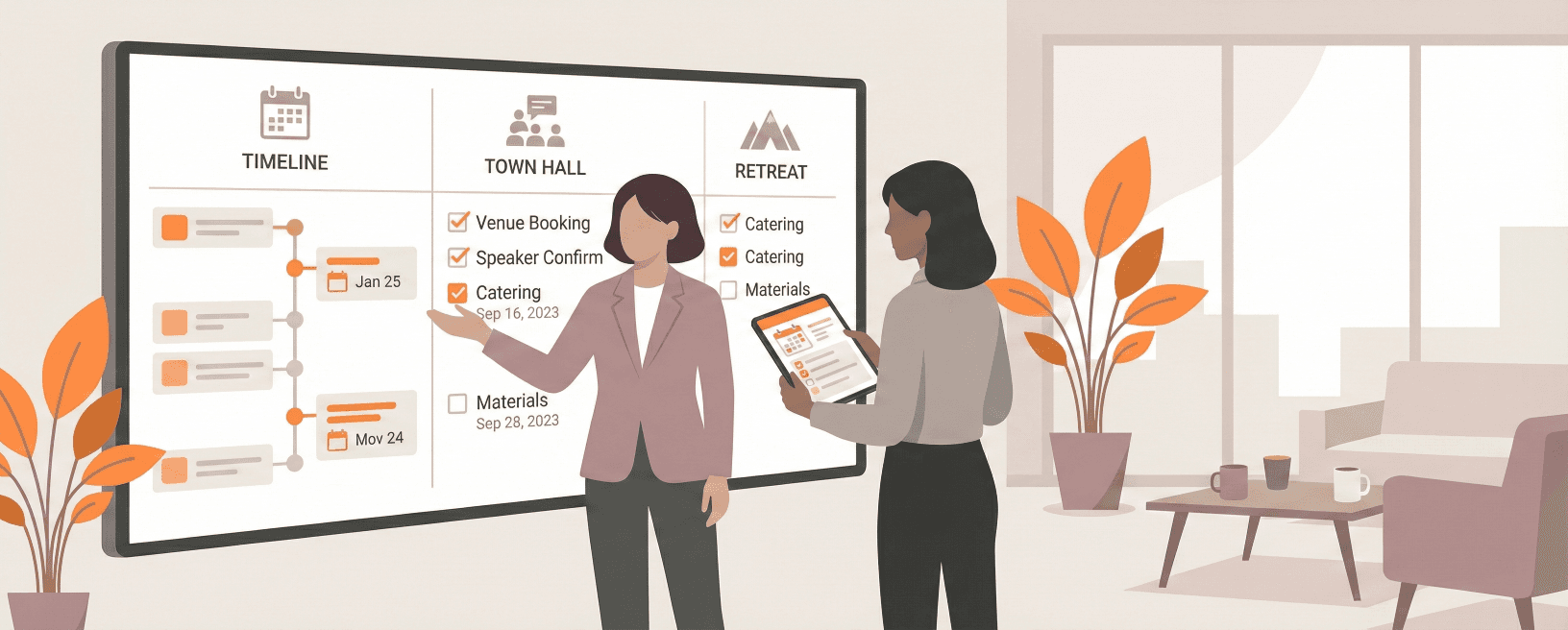
You're organizing the company's quarterly town hall for 150 people. You start a planning document and immediately realize you're forgetting critical details—do you need AV setup? When should you send calendar invites? Who orders catering? Three weeks before the event, you discover the venue requires insurance certificates you don't have, catering needs a 10-day lead time you've missed, and nobody's created the presentation deck. The day of the event, you're frantically troubleshooting Zoom links, chasing down the catering delivery, and realizing you forgot to arrange parking validation. Post-event, leadership asks why the Q&A session ran 30 minutes over and pushed everyone into their next meetings. The answer: you had no timeline, just a vague sense of "things to do eventually."
Time saved: Reduces 4-6 hours of checklist creation and timeline planning to under 30 minutes
Consistency gain: Standardizes event execution across all company gatherings, ensuring critical tasks never get forgotten regardless of who's planning or event complexity
Cognitive load: Eliminates the mental burden of remembering every detail, tracking dependencies, and constantly worrying "what am I forgetting?"
Cost comparison: Prevents event failures that damage reputation and waste investment—when a $15K offsite goes poorly because nobody coordinated logistics, you've lost the money plus the opportunity cost of 50 employees spending a day at an ineffective event, totaling $30K-40K in wasted resources
This task is perfect for AI delegation because it requires comprehensive planning (covering all event components), dependency sequencing (ordering tasks logically), and timeline development—exactly what AI handles systematically when given proper event parameters and organizational requirements.
Here's how to delegate this effectively using the 5C Framework.
Why This Task Tests Your Delegation Skills
Creating event planning checklists reveals whether you understand systems design versus task listing. An effective event checklist isn't just remembering activities—it's designing a coordinated system where tasks happen in the right sequence with appropriate lead times, dependencies are managed, and nothing falls through the cracks under time pressure.
This is delegation engineering, not prompt hacking. Just like training an event coordinator, you must define:
- Completeness criteria (what makes a checklist comprehensive vs. missing critical elements?)
- Timing logic (when must each task complete to avoid bottlenecks?)
- Ownership structure (who's responsible for which components?)
The 5C Framework forces you to codify these project management principles into AI instructions. Master this SOP, and you've learned to delegate any complex planning task—from product launches to client implementations to organizational change initiatives.
Configuring Your AI for Event Planning Checklists
| 5C Component | Configuration Strategy | Why it Matters |
|---|---|---|
| Character | Event planner and project manager with expertise in corporate events, vendor coordination, and timeline development | Ensures AI applies event logistics knowledge—understanding that venue contracts need 60+ days, AV testing happens day-before not day-of, catering minimums drive headcount decisions, and that successful events require task sequencing, not just task listing |
| Context | Event type and purpose (town hall/retreat/celebration/training), size and audience, budget constraints, venue type (in-office/external/virtual/hybrid), organizational culture and expectations | Different events need different planning depth—all-hands require executive coordination; client events demand polished details; team retreats need activity planning; virtual events require technology backup plans; regulated industries may need compliance documentation |
| Command | Generate comprehensive timeline-based checklist covering all event components with specific deadlines, task owners, dependencies, vendor requirements, and contingency plans | Prevents planning failures that doom events—missing critical lead times (venue booking, catering orders), forgetting essential components (parking, accessibility, dietary accommodations), or creating task lists so generic they don't actually guide execution |
| Constraints | Never create unrealistic timelines (don't assume same-day vendor responses); flag tasks requiring specialized skills or authority; note dependencies that must complete before others start; respect typical vendor lead times; include buffer time for delays | Stops AI from creating impossible plans—suggesting you book catering three days before when minimums require 10-day notice, assuming instant venue confirmation, or sequencing tasks illogically (sending invites before securing venue, ordering food before confirming attendance) |
| Content | Provide examples of successful event plans from past company events, showing timeline structures, task ownership patterns, typical vendor requirements, and lessons learned from previous events | Teaches AI your organization's conventions—whether you always use specific vendors (preferred caterer), have standard event templates (town hall format), require certain approvals (executive presence, budget sign-off), or have cultural preferences (always provide vegetarian options, accessibility is non-negotiable) |
The Copy-Paste Delegation Template
<role>
You are an event planner and project manager with expertise in corporate event logistics, vendor coordination, and timeline development. You understand how to create comprehensive checklists that account for dependencies, lead times, and the details that make events successful.
</role>

<context>
I need a comprehensive event planning checklist with timeline.

**Event Details:**
- Event type: [Town hall / Team offsite / Client event / Training / Celebration / Conference]
- Purpose: [Why we're doing this - align team, celebrate milestone, train skills, etc.]
- Date: [Specific date or target timeframe]
- Duration: [Hours or days]
- Attendees: [Number and types - all employees, leadership, specific department, clients]

**Logistics:**
- Format: [In-person / Virtual / Hybrid]
- Venue: [Specific location if known, or type needed - conference room, hotel, offsite venue]
- Budget: [Total available, or ranges for key components]
- Time: [Start and end times, including any specific schedule elements]

**Event Components:**
[Check all that apply and provide details]
- Presentations/speakers: [Who, what topics, how long]
- Meals/catering: [Breakfast, lunch, dinner, snacks]
- Activities: [Team building, workshops, entertainment]
- AV/tech needs: [Presentations, video, live streaming, recording]
- Materials: [Handouts, swag, name tags, signage]
- Transportation: [Shuttles, parking, directions]

**Organizational Context:**
- Decision makers: [Who needs to approve what]
- Typical lead times: [Your vendors' usual requirements]
- Past lessons: [What went wrong before that we need to avoid]
- Cultural requirements: [Accessibility, dietary, inclusion considerations]
- Constraints: [Budget limits, vendor restrictions, timing restrictions]

**Current Planning Status:**
- Time until event: [Weeks/months available for planning]
- What's decided: [Venue confirmed, speakers lined up, etc.]
- What's unknown: [Decisions still needed]
</context>

<instructions>
Follow this sequence:

1. **Analyze event requirements** to identify:
   - All major event components needed
   - Critical path items (longest lead time or most dependencies)
   - Decision points requiring approval or input
   - Vendor coordination needs
   - Risk areas requiring contingency plans

2. **Create timeline structure** working backward from event date:

   **12+ Weeks Before (if applicable):**
   - Venue research and booking
   - Budget approval
   - Save-the-date communications
   - Keynote speaker confirmation

   **8-12 Weeks Before:**
   - Detailed agenda development
   - Vendor identification and RFPs
   - Registration/RSVP system setup
   - Hotel room blocks (for multi-day events)

   **6-8 Weeks Before:**
   - Catering selection and menu planning
   - AV/tech requirements finalization
   - Materials design begins
   - Transportation/parking arrangements

   **4-6 Weeks Before:**
   - Formal invitations/calendar holds
   - Venue contract finalization
   - Presentation creation begins
   - Special accommodations deadline

   **2-4 Weeks Before:**
   - Final headcount to caterer
   - AV run-through scheduled
   - Materials printing/ordering
   - Day-of logistics plan drafted

   **1-2 Weeks Before:**
   - Final agenda published
   - Presenter preparation/rehearsals
   - Venue walkthrough
   - Staff assignments confirmed

   **Week Of Event:**
   - Final headcount confirmations
   - Materials pickup/delivery
   - Technology testing
   - Day-of timeline creation

   **Day Before:**
   - Venue setup
   - AV testing
   - Materials staging
   - Troubleshooting dry-run

   **Day Of Event:**
   - Early setup check
   - Registration/check-in setup
   - Real-time coordination
   - Issue triage

   **Post-Event:**
   - Venue cleanup/checkout
   - Vendor payments/tips
   - Feedback collection
   - Post-mortem and lessons learned

3. **Build comprehensive checklist** for each phase:

   For each task, specify:
   - **Task:** [Specific action to complete]
   - **Owner:** [Who is responsible]
   - **Deadline:** [Specific date, X weeks before, or "Day of"]
   - **Dependencies:** [What must be done first]
   - **Vendor/Contact:** [Who to coordinate with]
   - **Budget:** [Cost estimate if applicable]
   - **Status:** [Not started / In progress / Complete]
   - **Notes:** [Special requirements, tips, lessons learned]

4. **Structure the output:**
EVENT PLANNING CHECKLIST
Event: [Name/Type]
Date: [Event date]
Attendees: [Count]
Owner: [Primary planner]
Created: [Today's date]
=== CRITICAL PATH ITEMS ===
[Tasks with longest lead times or most dependencies - these cannot slip]
=== TIMELINE & TASKS ===
12 WEEKS BEFORE ([Specific date])
☐ Secure Venue
Owner: [Name]
Action: Research options, get quotes, book venue
Dependencies: Budget approval
Notes: Need capacity for [X] people, AV capabilities, catering allowed
Cost: $[estimate]
☐ Budget Approval
Owner: [Name]
Action: Create budget proposal, get CFO sign-off
Dependencies: None (start immediately)
Notes: Include venue, catering, materials, contingency (10%)
[Continue for each task in each timeframe]
=== VENDOR CONTACT LIST ===

Venue: [Name, phone, email, contract deadline, payment schedule]
Catering: [Details, minimum lead time, dietary accommodation process]
AV/Tech: [Details, setup time needed, backup equipment]
[Other vendors]

=== DECISION TRACKER ===
[Major decisions needed, who decides, by when]

Keynote speaker selection: [Owner] by [Date]
Menu choices: [Owner] by [Date]
Budget allocation: [Owner] by [Date]

=== CONTINGENCY PLANS ===

Weather backup (for outdoor events)
Technology failure plans
Speaker cancellation backup
Catering shortage/dietary emergency
Venue issues day-of

=== DAY-OF TIMELINE ===
[Hour-by-hour schedule for event day execution]
=== POST-EVENT TASKS ===
[Wrap-up, payments, thank-yous, retrospective]

5. **Apply event planning best practices:**
   - Build in buffer time (vendors are late, decisions take longer)
   - Assign clear ownership (one person per task)
   - Note dependencies explicitly (can't order food before headcount)
   - Include typical lead times (catering 10 days, venue 60+ days)
   - Plan for common issues (dietary needs, accessibility, AV failure)
   - Create day-of runbook (hour-by-hour, not just task list)

6. **Quality controls:**
   - Verify timelines work backward from event date correctly
   - Ensure all standard event components are covered
   - Check that dependencies are logical (order makes sense)
   - Confirm vendor lead times match reality
   - Validate that ownership is realistic (right people, right skills)
   - Include contingencies for high-risk items

Output as comprehensive, timeline-based checklist ready to execute.
</instructions>

<input>
Provide your event planning details:

Example format:
"Event: Q1 All-Hands Town Hall
Purpose: Share company results, announce Q2 priorities, team alignment
Date: March 15, 2026 (8 weeks away)
Duration: 3 hours (9am-12pm)
Attendees: 150 employees (in-office and remote)
Format: Hybrid - main office conference center with Zoom for remote
Budget: $8,000

Components:
- CEO presentation (30 min)
- Department updates from 4 VPs (10 min each)
- Q&A session (45 min)
- Breakfast and coffee service
- Swag bags for in-person attendees
- Professional recording for archive

Venue: Our main conference room (capacity 100, need overflow for 50 more)
Tech: Need presentation screens, mics, Zoom setup, recording equipment
Catering: Continental breakfast, coffee service throughout

Known requirements:
- Closed captions for accessibility
- Dietary accommodations (3 vegan, 2 gluten-free)
- Exec team needs rehearsal day before
- IT needs 2-day notice for Zoom setup

Current status:
- Conference room reserved
- Date on execs' calendars
- Budget approved
- Nothing else started yet"

[PASTE YOUR EVENT DETAILS HERE]
</input>
The Manager's Review Protocol
Before executing AI-generated event planning checklists, apply these quality checks:
- Accuracy Check: Verify all timeline calculations work backward correctly from the event date—if event is March 15 and catering needs 10-day notice, deadline is March 5, not "10 days before." Cross-reference vendor lead times against your actual vendors' requirements (AI might assume standard lead times that don't match your specific providers). Confirm that budget allocations add up correctly and fit within your total budget. Validate that assigned task owners actually have the authority and skills for their responsibilities.
- Hallucination Scan: Ensure AI didn't invent venue capabilities you don't have (like claiming your conference room has built-in AV when it doesn't). Verify that vendor contacts and requirements are accurate to your organization, not generic assumptions. Check that suggested contingency plans are realistic for your context (don't plan "outdoor backup" for an event that's already indoors). Confirm that compliance or approval requirements mentioned actually exist in your organization.
- Tone Alignment: Confirm the planning detail level matches your event's complexity and your organizational expectations—executive offsites deserve comprehensive planning; casual team lunches need lighter checklists. Verify that timeline urgency is appropriate (don't create artificial panic for events months away, but do flag genuine crunch times). Check that task descriptions provide enough specificity to guide execution without micromanaging experienced planners.
- Strategic Fitness: Evaluate whether the checklist actually prevents common event failures in your context—does it address the issues that went wrong in past events? Consider organizational capacity—is this realistic given your team's bandwidth and competing priorities, or does it assume dedicated event planning resources you don't have? Assess whether dependencies and sequencing match your decision-making culture (some orgs decide quickly, others require multiple approval rounds). Strong delegation means knowing when AI's comprehensive plan is overkill (for simple events) or insufficient (missing organization-specific requirements like executive gift protocol) based on institutional knowledge.
Build your SOP Library, one drop at a time.
We are constantly testing new ways to delegate complex work to AI. When we crack the code on a new "Job to be Done," we send the SOP directly to you, fresh from the lab.
Our Promise: High signal, low noise. We email you strictly once a week (max), and only when we have something worth your time.
When This SOP Isn't Enough
This SOP solves individual event planning, but managers typically face comprehensive event program challenges—managing recurring event series with consistent quality, coordinating across multiple simultaneous events, building event playbooks that enable team members to plan without constant oversight, and measuring event ROI to justify continued investment. The full 5C methodology covers event operations systems (templated playbooks for common event types), vendor relationship management (preferred vendor panels and negotiated rates), and event effectiveness frameworks (measuring whether events achieve their intended business outcomes).
For planning individual company events, this template works perfectly. For managing enterprise event programs, conference series, or building systematic event management capabilities, you'll need the advanced delegation frameworks taught in Sorai Academy.