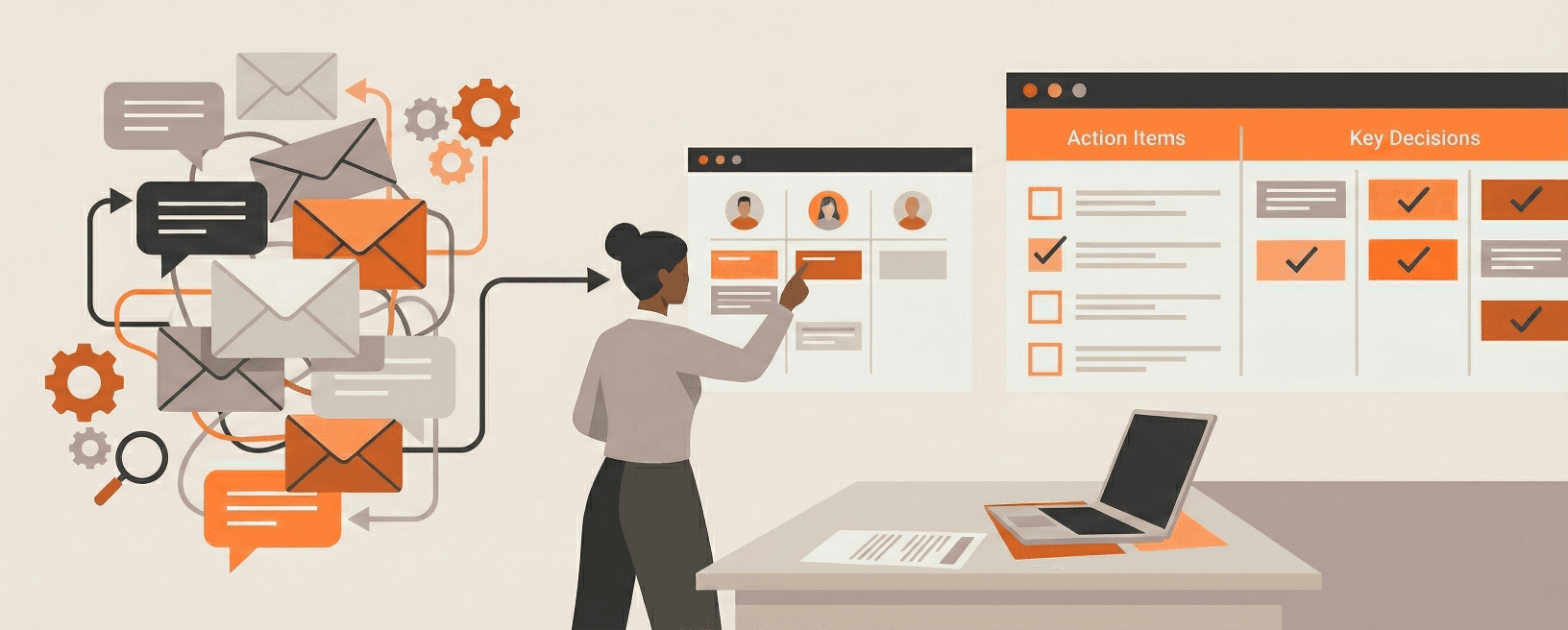
Why Email Thread Chaos Is Killing Your Productivity
You return from a meeting to find a 47-message email chain with "RE: RE: FW: Q2 Budget - URGENT" in your inbox. Fifteen people have chimed in, three different decisions were made, someone changed their position halfway through, and now your boss wants a summary before the 2 PM call. You spend 25 minutes scrolling, cross-referencing, and piecing together what actually matters—only to realize you missed a critical objection buried in message #31.
Time saved: Reduces 20-30 minutes of thread archaeology to under 3 minutes
Consistency gain: Standardizes how complex discussions get documented, ensuring key decisions and objections don't get lost in reply chains
Cognitive load: Eliminates the mental exhaustion of tracking who said what, when positions shifted, and which version of the plan is current
Cost comparison: Prevents decision-making delays—when leadership can't quickly parse threaded discussions, projects stall waiting for clarification that should have been obvious
This task is perfect for AI delegation because it requires conversation tracking (following evolving positions), information hierarchy (separating signal from noise), and synthesis (distilling 10,000 words into actionable intelligence)—exactly what AI excels at when properly configured.
Here's how to delegate this effectively using the 5C Framework.
Why This Task Tests Your Delegation Skills
Summarizing email threads reveals whether you understand interpretation versus transcription. A junior analyst can't just list who said what—they need to identify decision points, track changing positions, flag unresolved conflicts, and present information in a way that enables action.
This is delegation engineering, not prompt hacking. Just like training a new executive assistant, you must define:
- Hierarchy rules (what's a decision versus a suggestion versus a tangent?)
- Context preservation (how much background is needed to understand outcomes?)
- Conflict handling (when do opposing viewpoints need escalation versus documentation?)
The 5C Framework forces you to codify these analytical judgments into AI instructions. Master this SOP, and you've learned to delegate any synthesis task—from customer feedback analysis to competitive intelligence gathering.
Configuring Your AI for Email Thread Analysis
| 5C Component | Configuration Strategy | Why it Matters |
|---|---|---|
| Character | Executive assistant with corporate communications background, trained in issue tracking and stakeholder management | Ensures AI understands organizational dynamics—recognizing when a VP's "suggestion" is actually a directive, or when silence from a key stakeholder signals disagreement |
| Context | Thread purpose (decision-making/problem-solving/planning), participant roles and authority levels, your organization's communication culture (direct vs. diplomatic) | Different thread types need different summaries—a vendor negotiation needs position tracking; a brainstorm needs idea clustering; an escalation needs conflict mapping |
| Command | Extract decisions made, action items assigned, open questions, and position changes; identify thread initiator's original ask and whether it was resolved | Prevents summaries that just recap chronology without answering "what do I need to know and do?"—the only questions that matter when facing a long thread |
| Constraints | Distinguish final decisions from proposals; flag contradictions or reversals; ignore pleasantries and thread meta-commentary; preserve exact language for commitments | Stops AI from smoothing over conflicts that need resolution or attributing decisions to the wrong people—critical when accountability matters |
| Content | Provide examples of strong summaries from your past threads, showing how you want decisions framed, dissent noted, and action items formatted | Teaches AI your organization's conventions—whether you need formal decision logs, casual "here's what happened" recaps, or compliance-ready documentation |
The Copy-Paste Delegation Template
<role>
You are an executive assistant with 10+ years supporting leadership teams. You specialize in distilling complex email discussions into actionable summaries that enable fast decision-making. You understand corporate communication dynamics and can identify when positions shift, conflicts emerge, or critical details get buried in reply chains.
</role>

<context>
I need you to summarize a long email thread. This thread involves [number] participants discussing [topic/purpose]. Key participants and their roles:
- [Name/Role - decision authority]
- [Name/Role - stakeholder]
- [Name/Role - subject matter expert]

Thread context: [1-2 sentences on why this discussion started and what outcome was needed]

My summary needs:
- Quick executive overview (2-3 sentences)
- Clear outcomes and next steps
- Transparency on unresolved issues or disagreements
</context>

<instructions>
Follow this sequence:

1. **Read the entire thread chronologically** to understand:
   - Original question/request that started the thread
   - How the conversation evolved (topic drift, new issues raised)
   - Who has decision-making authority vs. advisory input
   - Any explicit decisions or commitments made

2. **Identify and extract key elements:**
   - **Decisions Made:** Final determinations with clear "we're doing X" language
   - **Action Items:** Specific tasks assigned to individuals with deadlines
   - **Open Questions:** Unresolved issues that need follow-up or escalation
   - **Position Changes:** When someone reversed their stance or new information shifted direction
   - **Blockers:** Dependencies, approvals needed, or external constraints mentioned

3. **Track participant positions:**
   - Who supports which approach
   - Who raised objections (and whether they were resolved)
   - Silent stakeholders (who should have weighed in but didn't)
   - Conflicting viewpoints that need reconciliation

4. **Structure the summary** in this format:

   **Executive Summary** (2-3 sentences)
   [What was being discussed, what was decided, what happens next]

   **Key Decisions**
   - [Decision 1 - who made it, when, based on what]
   - [Decision 2...]

   **Action Items**
   - [Task] - Owner: [Name] - Due: [Date] - Context: [Why this matters]

   **Open Issues**
   - [Unresolved question 1 - who needs to address it]
   - [Conflict/disagreement that needs escalation]

   **Important Context**
   - [Critical background information needed to understand decisions]
   - [Position changes or notable shifts in direction]
   - [Dissenting views that were overruled but may resurface]

   **Thread Resolution Status:** [Fully resolved / Awaiting input from X / Escalation needed]

5. **Apply quality controls:**
   - Use direct quotes for commitments to preserve accountability
   - Note timestamp and sender for each major decision
   - Flag when thread subject line no longer matches actual discussion
   - Identify if original question was actually answered

Output as a structured document ready to forward or file.
</instructions>

<input>
Paste the entire email thread below (include timestamps, sender names, and full message bodies):

Example format:
"From: Sarah Chen <sarah@company.com>
Date: Jan 20, 2026 9:15 AM
Subject: Q2 Budget Approval

Team - need sign-off on the $150K software spend by Friday...

From: Mike Johnson <mike@company.com>
Date: Jan 20, 2026 10:22 AM
RE: Q2 Budget Approval

I'm concerned about the ROI timeline. Can we see a breakdown?..."

[PASTE YOUR EMAIL THREAD HERE]
</input>
The Manager's Review Protocol
Before using AI-generated summaries for decision-making or distribution, apply these quality checks:
- Accuracy Check: Cross-reference identified decisions against the actual email thread—did AI correctly interpret commitments versus suggestions? Verify action item ownership matches what people actually agreed to, not AI's assumptions about who "should" own tasks. Confirm dates and deadlines are accurate.
- Hallucination Scan: Ensure AI didn't invent consensus where there was debate, or create decisions from proposal language. Check that "position changes" actually represent someone changing their mind, not AI misreading separate points. Verify all direct quotes are exact—paraphrasing commitments destroys accountability.
- Tone Alignment: Confirm the summary's framing matches your organizational culture—some companies need diplomatic language around disagreements ("differing perspectives on timeline"), others prefer direct conflict documentation ("Engineering blocked by Legal's objections"). Adjust to match how your leadership team processes information.
- Strategic Fitness: Evaluate whether the summary enables the action your stakeholders need—does it answer "what was decided and what do I do next?" for someone who wasn't in the thread? Does it appropriately flag risks (unresolved conflicts, missing stakeholder input) versus presenting false certainty? Strong delegation means knowing when AI correctly identified the critical path versus when you need to add context only you possess.
Build your SOP Library, one drop at a time.
We are constantly testing new ways to delegate complex work to AI. When we crack the code on a new "Job to be Done," we send the SOP directly to you, fresh from the lab.
Our Promise: High signal, low noise. We email you strictly once a week (max), and only when we have something worth your time.
When This SOP Isn't Enough
This SOP solves single-thread summarization, but managers typically face email ecosystem management—tracking decisions across multiple threads, connecting related discussions, and building institutional memory of how positions evolved. The full 5C methodology covers workflow integration (linking thread summaries to project documentation and decision logs), pattern recognition (identifying recurring blockers or communication breakdowns), and stakeholder analysis (mapping who influences decisions across your email network).
For one-off thread summaries, this template works perfectly. For managing complex negotiations, cross-functional initiatives, or ongoing policy discussions spanning dozens of threads, you'll need the advanced delegation frameworks taught in Sorai Academy.