Why You're Wasting Hours on the Wrong LinkedIn Profiles
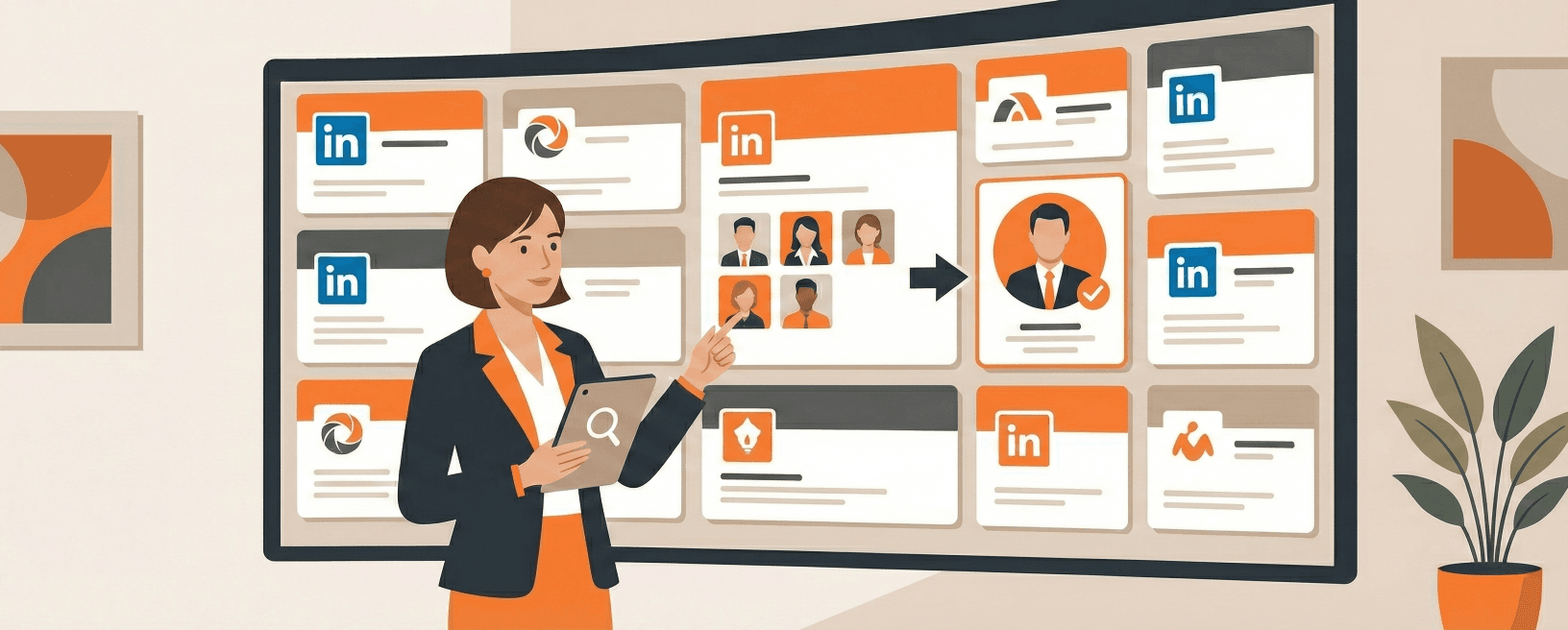
You open a target company's LinkedIn page and start scrolling. Who's the actual buyer? The VP of Engineering has "procurement" in their background, but the Director of IT Operations posted about vendor selection last month. You click through seven profiles, cross-reference org charts, check recent job changes, and still aren't sure if you should pitch to the technical evaluator or the budget holder. Thirty minutes later, you've built a contact list that's 60% wrong because LinkedIn job titles rarely map to purchasing authority.
Time saved: Reduces 20-30 minutes of manual research per company to under 3 minutes of AI-assisted analysis
Consistency gain: Standardizes decision-maker identification criteria across your entire pipeline, ensuring reps target the same buyer personas using consistent logic instead of individual guesswork
Cognitive load: Eliminates the mental effort of parsing org hierarchies, decoding ambiguous job titles, and cross-referencing signals to determine who actually controls the budget
Cost comparison: For a sales team researching 50 accounts weekly, this saves 20+ hours of rep time monthly—time better spent on actual outreach. At $75K average sales salary, that's $1,800/month in reclaimed productivity, not counting the revenue impact of targeting the right people faster.
This task is perfect for AI delegation because it requires pattern recognition across multiple data points (job titles, seniority, department, recent activity), structural analysis (understanding reporting hierarchies), and inference (determining who holds budget authority vs. technical influence). AI processes these signals simultaneously while you focus on crafting the pitch.
Here's how to delegate this effectively using the 5C Framework.
Why This Task Tests Your Delegation Skills
Identifying decision makers reveals whether you understand research delegation versus task automation. A junior SDR can't deliver useful contact lists without knowing your ICP, understanding the difference between champions and economic buyers, and recognizing how purchasing authority varies by company size and industry.
This is delegation engineering, not prompt hacking. Just like training a new sales researcher, you must specify:
- Buyer persona definitions (what titles/roles constitute "decision maker" in your context?)
- Company context signals (how does org structure affect who controls purchasing?)
- Validation criteria (what evidence confirms someone has budget authority versus technical influence?)
The 5C Framework forces you to codify these qualification criteria into AI instructions. Master this SOP, and you've learned to delegate any prospect research task—from competitive intelligence gathering to account mapping for enterprise deals.
Configuring Your AI for Decision Maker Identification
| 5C Component | Configuration Strategy | Why it Matters |
|---|---|---|
| Character | B2B sales researcher specializing in organizational analysis and buyer persona mapping, experienced in parsing LinkedIn company pages and org charts | Ensures AI applies sales qualification logic—understanding reporting structures, budget authority levels, and the difference between users, influencers, and economic buyers—not just listing executives |
| Context | Your ICP parameters (company size, industry, deal size), typical sales cycle (single-threaded vs. committee-based), product category (determines which departments hold purchasing authority) | Different solutions sell to different buyers—a DevOps tool targets engineering leadership while procurement software sells to finance; AI needs your GTM context to identify the right decision makers |
| Command | Parse the LinkedIn company page to identify individuals matching decision maker criteria; distinguish between economic buyers, technical evaluators, and champions; provide reasoning for each selection | Prevents generic "find executives" outputs and ensures AI explains its logic—why this VP matters more than that Director—so you can validate the research instead of blindly trusting it |
| Constraints | Return maximum 3-5 decision maker profiles per company; prioritize current employees (exclude alumni/former); flag uncertainty when job titles are ambiguous; exclude pure technical roles unless they match your buyer persona | Stops AI from overwhelming you with 20 marginally relevant contacts and ensures focus on genuine purchasing authority, not organizational noise |
| Content | Provide examples of ideal decision maker profiles from past deals (job titles, seniority, departments); specify industry-specific role variations (e.g., "CTO" in 50-person startups vs. "VP of Infrastructure" in enterprises) | Teaches AI your company's buyer persona nuances—whether you sell to practitioners or executives, technical buyers or business buyers, and how titles translate across company sizes |
The Copy-Paste Delegation Template
<role>
You are a B2B sales researcher specializing in organizational analysis and decision-maker identification. You understand corporate hierarchies, budget authority distribution, and how purchasing decisions flow through different company sizes and industries. You recognize the difference between economic buyers (budget holders), technical evaluators (solution assessors), and champions (internal advocates).
</role>

<context>
I need to identify decision makers at target companies by analyzing their LinkedIn company pages.

Our sales context:
- Product/Service: [Describe what you sell in one sentence]
- Ideal Customer Profile: [Company size, industry, revenue range]
- Typical buyer personas: [Job titles/roles who typically purchase your solution]
- Deal size: [Average contract value]
- Sales cycle: [Single decision maker / committee-based / multi-stakeholder]
- Decision maker characteristics: [What defines purchasing authority in your context - e.g., "budget owner for IT infrastructure," "head of sales operations," "C-level for strategic initiatives"]

Company size context (how authority varies):
- <50 employees: [Who typically decides? Often founders/C-suite]
- 50-200 employees: [Department heads gain authority]
- 200-1000 employees: [VPs and Directors control budgets]
- 1000+ employees: [Procurement involvement, multiple approvers]
</context>

<instructions>
Follow this research sequence:

1. **Parse organizational structure** from the LinkedIn company page:
   - Identify departments relevant to our solution (e.g., Engineering, IT, Sales Operations, Marketing)
   - Map leadership hierarchy (C-suite → VPs → Directors → Managers)
   - Note company size to calibrate seniority expectations
   - Flag if key departments are absent (may indicate wrong target company)

2. **Identify potential decision makers** using these criteria:
   - Job title contains decision-making authority keywords (VP, Director, Head of, Chief)
   - Department aligns with our buyer personas
   - Seniority level appropriate for our deal size (don't target CEOs for $10K deals; don't target junior managers for $500K strategic purchases)
   - Recent activity/tenure suggests they're actively engaged (not placeholder profiles)

3. **Classify each potential contact** into buyer type:
   - **Economic Buyer:** Budget authority, signs contracts (prioritize for outreach)
   - **Technical Evaluator:** Assesses solution fit, influences selection (important for demos)
   - **Champion:** Internal advocate, may not have authority but drives process (valuable for multi-threading)
   - Note: One person may fill multiple roles in smaller companies

4. **Validate decision maker fit** by checking:
   - Does their scope match our solution domain? (e.g., "VP of Sales Enablement" for a sales tool, not "VP of HR")
   - Is seniority appropriate for purchasing authority? (Director-level can approve $50K in mid-market; needs VP approval in enterprise)
   - Any signals of active buying behavior? (recent posts about pain points, team expansion, budget allocation)
   - Do they have direct reports? (indicator of budget ownership)

5. **Prioritize and present findings:**
   - Rank contacts by likelihood of purchasing authority (primary decision maker first)
   - Provide reasoning for each selection (why this person over others)
   - Flag any ambiguity or uncertainty (e.g., "Title suggests budget authority but unclear if they own this domain")
   - Note if multiple approvers are likely required (committee buying signal)
   - Include LinkedIn profile URLs for each contact

Output format:
For each decision maker identified, provide:
- **Name:** [Full name]
- **Title:** [Current job title]
- **Buyer Type:** [Economic Buyer / Technical Evaluator / Champion]
- **LinkedIn URL:** [Profile link]
- **Reasoning:** [2-3 sentences explaining why this person is a decision maker for our solution - reference scope, seniority, department alignment]
- **Confidence Level:** [High / Medium / Low - based on title clarity and org structure visibility]
</instructions>

<input>
**LinkedIn Company Page URL:**
[Paste the target company's LinkedIn page URL here]
Example: https://www.linkedin.com/company/example-corp/people/

**Additional Context (optional):**
[Paste any additional information you have about the company's buying process, known contacts, recent news, or specific departments to focus on]

[PASTE YOUR INPUTS HERE]
</input>
The Manager's Review Protocol
Before reaching out to AI-identified contacts, apply these quality checks:
- Accuracy Check: Verify identified individuals still work at the company (check LinkedIn profile directly—people change jobs). Confirm job titles match what AI reported. Cross-reference with company website's leadership page if available. Ensure AI didn't confuse similar names or conflate multiple people.
- Hallucination Scan: Confirm AI didn't invent purchasing authority that doesn't exist in the job description. Watch for assumptions like "Director must have budget authority" without supporting evidence. Verify any claims about decision-making scope—did AI infer this from actual signals or just title assumptions? Check that reasoning aligns with your knowledge of how this company size/industry typically structures purchasing.
- Tone Alignment: Assess whether AI correctly interpreted your buyer persona—are these genuinely the people who buy your solution, or did it default to "senior = decision maker" logic? Verify seniority calibration matches your deal size (don't waste time pitching VPs if Directors typically buy). Confirm department alignment—AI should understand that "VP of Engineering" and "VP of Infrastructure" may target different solutions.
- Strategic Fitness: Evaluate multi-threading strategy—does the contact list support your sales motion (single champion vs. consensus building)? Are technical evaluators identified if your sale requires proof of concept? For enterprise accounts, did AI flag that multiple stakeholders will be involved? Strong delegation means recognizing when AI correctly prioritized economic buyers versus when you need to expand the list to include influencers and champions.
Build your SOP Library, one drop at a time.
We are constantly testing new ways to delegate complex work to AI. When we crack the code on a new "Job to be Done," we send the SOP directly to you, fresh from the lab.
Our Promise: High signal, low noise. We email you strictly once a week (max), and only when we have something worth your time.
When This SOP Isn't Enough
This SOP solves single-company decision maker identification, but sales teams typically face account research at scale—mapping buying committees across dozens of target accounts, tracking job changes among existing prospects, and building multi-touch sequences that engage different buyer personas. The full 5C methodology covers workflow integration (connecting prospect research to CRM enrichment and sequence automation), territory planning frameworks (systematically identifying and prioritizing accounts across your entire addressable market), and relationship mapping (understanding influence networks and referral paths within target organizations).
For one-off account research, this template works perfectly. For managing strategic account lists, territory optimization, or building repeatable research processes across your sales team, you'll need the advanced delegation frameworks taught in Sorai Academy.