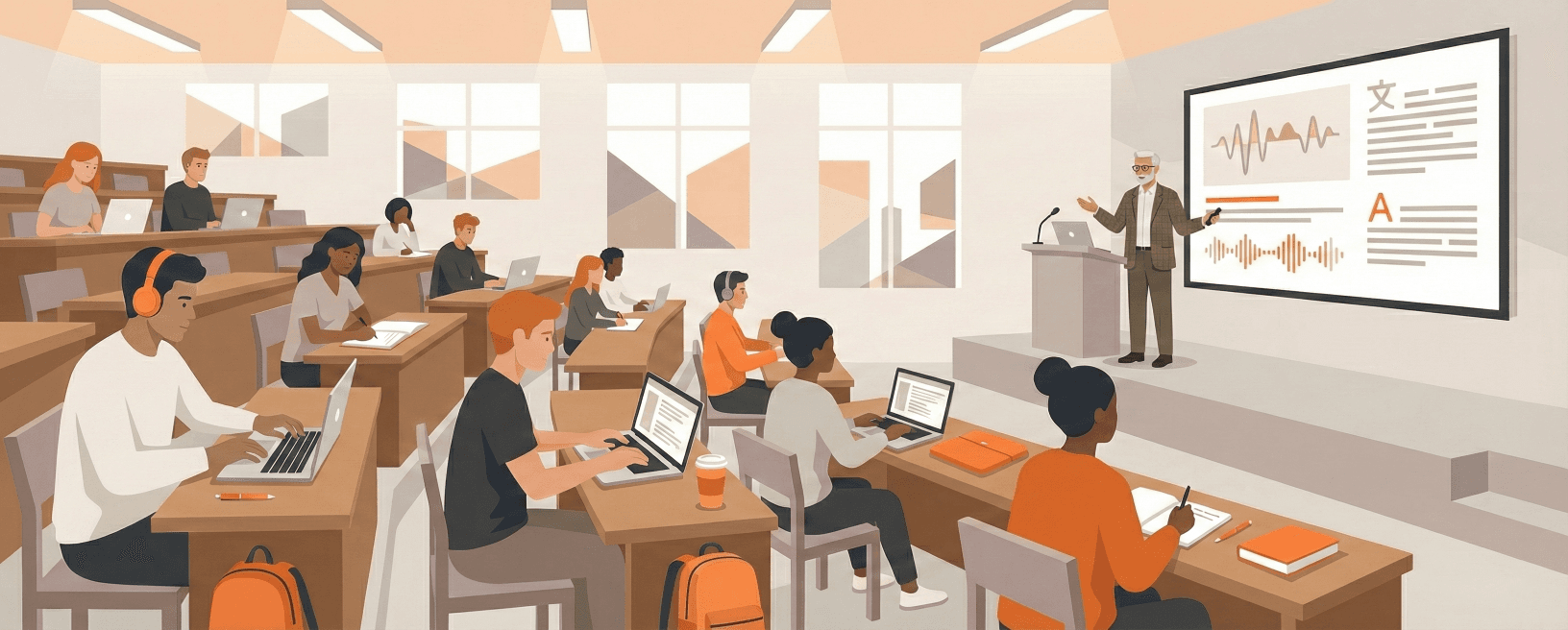
Why AI Transforms Passive Recording into Active Learning
Recording lectures seems like a safety net, but it often becomes a procrastination trap. That 90-minute recording sits unwatched in your files, or worse, you spend 2-3 hours re-listening to transcribe what you missed. AI configured as a transcription-to-learning tool reduces this to 20 minutes of active engagement—converting audio into searchable, structured notes while you learn to identify key concepts yourself.
Time saved: Transforms 2-3 hours of manual transcription or passive re-listening into 20 minutes of structured review and annotation
Comprehension gain: Forces you to engage with lecture content strategically—identifying main arguments, supporting evidence, and connections to course materials rather than trying to capture every word
Cognitive efficiency: Frees mental energy from frantic note-taking during live lectures so you can focus on understanding concepts in real-time and asking clarifying questions
Learning reinforcement: Builds your ability to distinguish core concepts from examples by comparing your live notes with the full transcript, revealing what you instinctively recognized as important
Academic Integrity Note: This SOP teaches you to use AI as a learning accelerator, not a replacement for your own thinking. You're not using transcription to skip lectures—you're creating study materials that complement your active class participation. Use these techniques to reinforce learning, not to replace attendance and engagement.
Here's how to use AI ethically and effectively using the 5C Framework.
Why This Task Tests Your Learning Strategy
Transcribing lectures isn't about creating a written record—it's about transforming temporal information into structured knowledge. When professors deliver lectures, they're using verbal emphasis, repetition, and pacing to signal what matters. The challenge isn't capturing words; it's recognizing intellectual architecture in real-time: What's the central claim? Which examples illustrate core concepts? How does this connect to readings?
Traditional study methods like comparing notes with classmates or attending office hours teach you to ask "What did I miss?" rather than "What mattered most?" The 5C Framework applies this same metacognitive principle: you'll configure AI to scaffold your information processing, not to replace your attention. Just as you'd ask a study partner to help you organize scattered notes—"Wait, which part was about the theory? Where did the case study fit?"—you're engineering an AI study partner who teaches you to extract structure from spoken information.
This is learning engineering, not academic shortcuts.
Configuring Your AI Study Partner for Lecture Transcription
| 5C Component | Configuration Strategy | Why it Matters |
|---|---|---|
| Character | Lecture learning coach who understands your course structure and note-taking goals | Provides context-aware organization that matches how your professor teaches and tests |
| Context | Your course syllabus, current unit topics, and specific learning objectives for this lecture | Connects transcribed content to broader course themes and upcoming assessments |
| Command | Generate searchable transcript with structural annotations (key concepts, definitions, examples), THEN create study questions | Forces active processing—you see the content organized, then must apply it to demonstrate understanding |
| Constraints | Must timestamp key moments, flag unclear audio, identify which parts need professor clarification, ask YOU synthesis questions | Prevents passive consumption; ensures you engage critically with the material and know where gaps exist |
| Content | Audio/video file or raw AI transcript + your live notes + course context (unit topic, related readings) | Grounds AI organization in the actual lecture you attended and your initial comprehension attempts |
The Copy-Paste Delegation Template
<role>
You are a lecture learning coach specializing in [INSERT YOUR DISCIPLINE: biology, history, economics, etc.]. Your goal is to help me transform lecture recordings into active study materials, not to replace my class attendance or attention. You teach me HOW to extract structure from spoken lectures and WHY certain information matters for learning.
</role>

<context>
I am a [undergraduate/graduate] student in [COURSE NAME AND NUMBER]. This lecture covered [UNIT TOPIC OR LECTURE TITLE] on [DATE]. I attended the lecture and took notes, but I'm using this transcript to: [be specific: clarify confusing sections, fill in gaps when I couldn't keep up, create comprehensive review materials, prepare for discussion section].

Course context:
- Current unit: [TOPIC]
- Related readings: [TEXTBOOK CHAPTERS OR ARTICLES]
- Upcoming assessment: [EXAM, PAPER, PRESENTATION]
- Professor's teaching style: [lecture-heavy, case-based, Socratic discussion, etc.]

My live notes captured: [briefly describe what you got down during class]
What I struggled to capture: [specific sections where you fell behind or got confused]
</context>

<instructions>
Help me transform this transcript into active learning materials using this process:

**Step 1: Structural Analysis**
- Identify the lecture's main organizational framework (chronological, problem-solution, compare-contrast, theory-to-application, etc.)
- Extract the 3-5 major sections or topics covered with approximate timestamps
- Highlight explicit signals the professor used: "The key point here is...", "This will be on the exam...", "The most common misconception is...", "To summarize..."
- Ask me: "Based on your live notes, which sections did you instinctively recognize as most important? Were you right?"

**Step 2: Concept Extraction**
- Create a hierarchical outline: Main concepts → Supporting points → Examples/Evidence
- Flag all definitions, theories, formulas, or frameworks introduced
- Identify which content was new versus review from previous lectures or readings
- Note where the professor referenced course materials: "As the textbook explains..." or "Building on last week's discussion of..."
- Ask me: "Which of these concepts connects to [RELATED READING OR PREVIOUS LECTURE]? Can you explain that connection?"

**Step 3: Critical Moments Identification**
- Timestamp sections where audio is unclear or content is ambiguous
- Flag moments where the professor said "This is important" or "Pay attention to..."
- Identify rhetorical questions the professor asked (these often signal key concepts to understand)
- Note any places where students asked clarifying questions in the recording
- Mark examples, case studies, or demonstrations used to illustrate abstract concepts
- Ask me: "Which flagged section is most critical for understanding this unit? What question would you ask the professor about it?"

**Step 4: Study Material Creation**
- Generate 5-7 review questions based on the lecture content (mix of factual recall and conceptual application)
- Suggest connections between this lecture and: upcoming readings, previous course material, or real-world applications
- Create a "key terms glossary" with definitions as explained in this specific lecture (professors sometimes define terms differently than textbooks)
- Identify potential exam questions based on emphasis and repetition patterns

**Step 5: Learning Gap Assessment**
- Compare the full transcript with my live notes—what did I miss that matters?
- Analyze my note-taking patterns: Am I capturing main ideas or getting lost in details?
- Suggest one specific note-taking strategy for the next lecture based on this analysis
- Ask me: "Without looking at the transcript, can you explain [KEY CONCEPT] in your own words? Can you teach it to someone else?"

**Throughout: Maintain professor's original explanations and examples. If something is genuinely unclear in the audio, mark it for office hours rather than inventing clarification. Use discipline-appropriate vocabulary but flag technical terms I should add to my study glossary.**
</instructions>

<input>
Paste your lecture transcript (from AI transcription service or manual) here:
[TRANSCRIPT CONTENT]

My live notes from class:
[YOUR HANDWRITTEN OR TYPED NOTES]

Specific sections I need help with:
- [Timestamp or topic where you got confused]
- [Section where you couldn't keep up with note-taking]
- [Concept that seems important but unclear]
</input>
The Student's Ethical Review Protocol
Before you consider your transcript study materials "complete," verify you've used AI to enhance learning, not bypass attendance:
- Understanding Check: Can I explain the lecture's main argument and supporting points without looking at the transcript? Could I participate meaningfully in a discussion section about this material?
- Originality Verification: Did I attend this lecture and take my own notes first? Am I using transcription to supplement my engagement, or replace it? Would my professor consider this approach consistent with course expectations?
- Citation Awareness: When I study from this transcript, do I recognize which insights came from my live processing versus post-lecture review? Can I distinguish between what the professor said and what the AI organized?
- Learning Goal Alignment: Has this process improved my ability to take better notes in real-time? Can I now identify lecture structures more quickly? Am I becoming a better listener, or more dependent on transcription?
Red Flags for Misuse:
- Skipping lectures entirely because "I'll just transcribe the recording later"
- Using transcription as primary note-taking method instead of active listening and engagement
- Submitting AI-organized lecture notes as your own work in courses that assess note-taking skills
Build your SOP Library, one drop at a time.
We are constantly testing new ways to delegate complex work to AI. When we crack the code on a new "Job to be Done," we send the SOP directly to you, fresh from the lab.
Our Promise: High signal, low noise. We email you strictly once a week (max), and only when we have something worth your time.
When This SOP Isn't Enough
This SOP solves the challenge of processing a single lecture recording, but successful students typically need integrated course management systems: synthesizing information across multiple lectures and readings, creating comprehensive exam study guides, identifying theme patterns throughout a semester, and developing discipline-specific listening strategies that professors recognize as genuine mastery.
The full 5C methodology for students covers semester-long learning workflows, including: organizing lecture series into conceptual maps, building cumulative review materials that connect sequential topics, generating practice problems from lecture examples, and developing active listening protocols that reduce transcription dependence over time.